
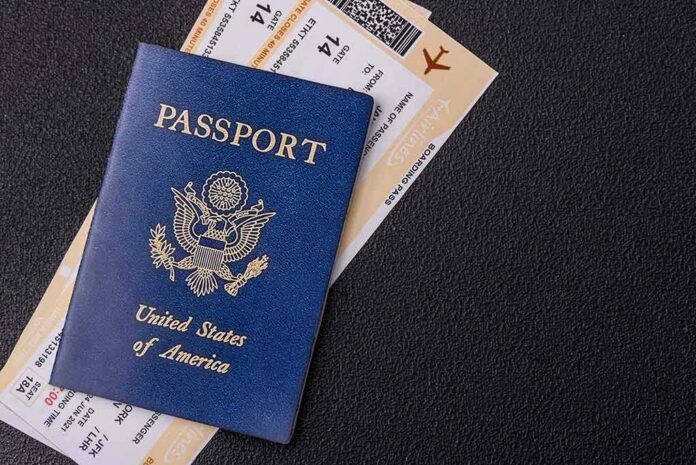
Federal prosecutors say facial recognition stopped two travelers at John Wayne Airport who tried to enter the United States with real passports that belonged to other Americans.
Story Snapshot
- Justice Department charged two Chinese nationals with misusing real U.S. passports at John Wayne Airport.
- Facial recognition flagged mismatched identities during inspection, prompting arrests.
- Case highlights growing use of biometrics at airports and related security gains.
- Alleged scheme fuels public worries about border gaps and identity theft.
What Prosecutors Allege Happened at John Wayne Airport
U.S. prosecutors in the Central District of California filed a criminal complaint against two Chinese nationals who arrived from Mexico at John Wayne Airport in August. Officials say each person presented a United States passport that belonged to someone else. Officers used inspection steps that included facial checks to spot the mismatch, then detained both travelers. The Justice Department announced the charges and said the pair face federal counts tied to misuse of passports.
The arrests took place in Orange County, a smaller but growing international entry point that works with United States Customs and Border Protection. The airport’s partnership supports identity checks for arrivals from abroad. Federal documents say the travelers’ faces did not match the passport photos, which led officers to dig deeper and make the arrests. The complaint describes the attempted entry from Mexico and the use of real, but not rightful, United States passports.
How Facial Recognition Flagged the Mismatch
Customs and Border Protection has rolled out facial recognition at airports to verify identity. The system compares a live image of a traveler to a photo from a passport, visa, or flight records. The Government Accountability Office reported that by 2020, the program operated at dozens of airports and helped catch impostors using genuine documents that did not belong to them. In this case, the face comparison at inspection reportedly alerted officers to a mismatch that triggered further review.
Federal privacy advisors have explained that the agency’s system draws on flight manifests and stored photos to confirm who is boarding or arriving. The process aims to speed lawful travel while stopping fraud. Supporters say the tools improve accuracy and reduce human error. Critics have asked for strict rules to protect data and limit bias. Both points can be true at once: the tools can help catch document fraud and still require careful oversight.
Why This Case Resonates Beyond One Airport
This case taps a deeper worry shared by many Americans. People on the right and the left fear that borders are too easy to game and that identity theft is rising. They see complex systems that are supposed to protect them, yet often seem slow or uneven. Here, technology appears to have worked as intended. Officers used facial checks to stop a suspected passport swap. That looks like a win for basic security and a small step toward a more trustworthy entry process.
2 Chinese nationals arrested at John Wayne Airport, allegedly used passports of American citizens https://t.co/103197HpXZ
— LB Press-Telegram (@presstelegram) September 30, 2026
At the same time, a federal charge is not a conviction. The defendants will have a chance to respond in court. Still, the complaint underlines the legal stakes. Federal law makes it a crime to make false statements in a passport application or to use a passport that was obtained by lies. Courts have upheld convictions for using a passport secured by false statements, even if the user did not make the lies themselves. The outcome in this case will hinge on the evidence and the law.
What to Watch Next
Watch for court filings that detail how the passports were obtained and how the journey from Mexico was arranged. Look for whether investigators link the case to a broader network that sells genuine documents to impostors. Follow any updates on how Customs and Border Protection will expand facial checks at smaller airports like John Wayne. Also track whether Congress or agencies add new privacy guardrails as biometric use grows across air, sea, and land ports.
Sources:
nypost.com, cbp.gov, doras.dcu.ie, justice.gov
© patriotspotlight.org 2026. All rights reserved.