

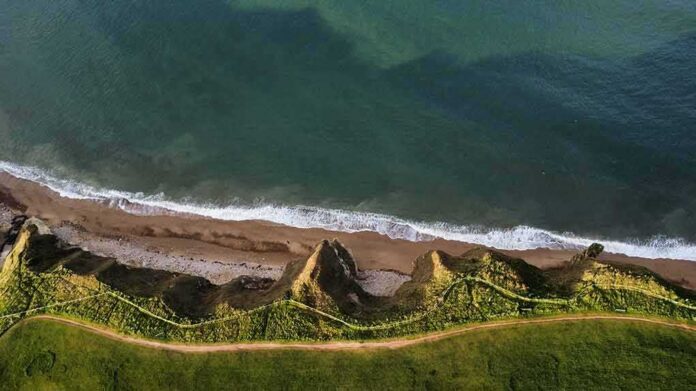
A long, visible crack has opened in the cliff above a packed public trail below The Ritz-Carlton, Laguna Niguel, just as strong storms and high tides line up along the Southern California coast.
Story Highlights
- Footage shows a large fissure in the bluff above Salt Creek Beach’s popular trail.
- Forecast rain and strong surf could add stress by soaking soil and scouring the bluff’s base.
- One report cites an approximate size of 360 feet long and two feet wide, attributed to Caltrans.
- Officials have not released a geological assessment confirming hotel danger or collapse timing.
What Happened on the Bluff Above Salt Creek Beach
Local videographer Craig Whetter recorded a clear fissure running along the bluff above the Salt Creek Point trail in Dana Point. He shared video in mid-November that shows a pronounced split in the ground near the cliff edge. Reporting tied the location to The Ritz-Carlton, Laguna Niguel, which sits atop the bluff. Stories emphasized the crack’s visibility and its position over a heavily used trail below the resort area.
Whetter said the fissure sits above “a very, very popular walkway that people use all day,” raising concerns about rockfall or sloughing onto people using the path. He warned that the situation “was putting a lot of people in danger.” Media accounts repeated that the trail draws steady foot traffic from beachgoers, surfers, and locals. That makes the location of the fracture a public-safety focus even without proof of damage spreading to structures above.
Why Upcoming Weather Raises the Risk
Forecast rain could enter the crack, soak the soil, and add weight to the upper bluff. Saturated ground can lose strength and slip more easily, especially in unconsolidated sediments. At the same time, high surf and elevated tides can erode the bluff’s base. That process can undercut support and steepen the slope. Reports flagged both hazards as storms approach, linking rain and powerful waves to possible bluff instability during the holiday week.
California’s own coastal guidance describes how several forces can act together on sea cliffs. Wave attack at the bluff toe can remove support, and groundwater or storm runoff can weaken upper layers. Erosion sometimes looks slow, but sudden slope failures also occur. The pattern is episodic retreat, not a smooth, steady march. That means long quiet periods can end with sharp losses when weather, tides, and geology line up the wrong way.
What We Know—and What Officials Have Not Said
One outlet reported an approximate size of 360 feet long and two feet wide, attributing the estimate to the California Department of Transportation. The report did not include a named official or a public document number for that measurement. Other coverage focused on the visible split and its location rather than precise engineering data, which had not been published at the time of reporting.
Reports also stated that authorities had not released a geological assessment showing the crack’s depth, how fast it is moving, or whether failure is imminent. Outlets distinguished concern for the trail and bluff from any confirmed threat to the hotel’s structure. The lack of a formal, public analysis leaves open questions about near-term behavior, even as weather and high tides add pressure to the site.
How This Fits a Larger Coastal Challenge
Southern California has seen repeated bluff failures over the years as development, recreation, and natural forces meet on the edge of the continent. Studies and agency reports explain that protection methods like seawalls and beach fills have limits. In some locations, repeated armoring or rebuilding becomes technically or economically hard to sustain. That debate often surfaces when a dramatic crack or slide forces a quick safety response at popular spots.
… less than a month after it sold… perhaps the biggest hotel deal in OC history.
The Ritz-Carlton Laguna Niguel sold in late October 2026 from Strategic Hotels & Resorts to KSL Capital Partners. CoStar puts the real-estate portion at $378 million, far below a 2026 assessment… https://t.co/ScZqrIQSJ4
— Brad Conley⚖️🇺🇸 (@JB_Conley) November 15, 2026
State documents describe trade-offs facing cities, property owners, and the public. Hardening coasts can save assets for a time but also shift erosion and shrink beaches. Retreat from the most exposed edges can reduce risk but brings cost and conflict. The Salt Creek fissure highlights how a single break in the ground can trigger those bigger questions. People want safe access, stable property, and open beaches, all at once, in a changing climate.
What to Watch Next
Local agencies and landowners will likely inspect the crack, the trail below, and the bluff face after the storms pass. Key signals include any widening at the surface, fresh slumps on the slope, or new undercutting at the base. If officials find movement, they could restrict access or add temporary controls. If the bluff steadies, they may still monitor it through the winter, when repeated storms can stack up stress on already weakened slopes.
For now, beach users and walkers should follow posted signs and detours. Simple steps help: avoid the bluff toe during high surf, stay off closed paths, and heed lifeguard and ranger instructions. Those precautions protect families while experts do the careful work. The goal is the same for everyone—keep people safe today and make smart choices about the coast we all share tomorrow.
Sources:
nypost.com, ftmq.com, unbiasedheadlines.com, newsfinale.com, publicnewznow.com, patch.com, yahoo.com
© patriotspotlight.org 2026. All rights reserved.