

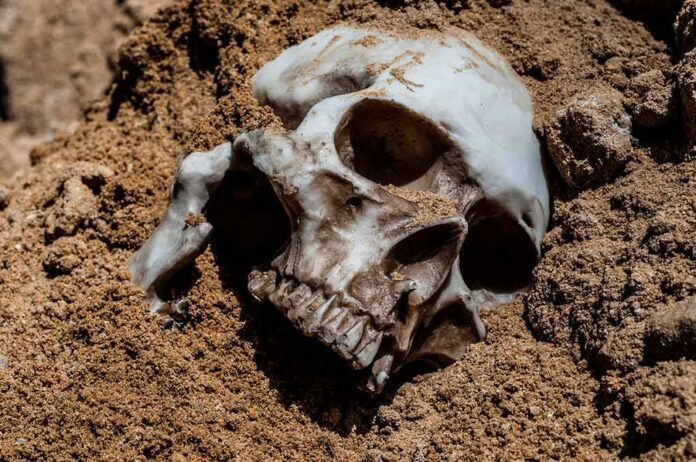
Fresh forensic scans of 5,000-year-old skulls from Egypt’s first kings’ tombs show violent head injuries in many attendants buried beside them, pointing to organized killing within the royal court.
Story Snapshot
- Modern analysis found serious cranial trauma in 18 of 46 skulls from royal-side graves.
- Injuries match blows, chops, and a penetrating strike, suggesting deliberate violence.
- The graves ring First Dynasty royal tombs at Umm el-Qa’ab, likely court attendants.
- Scholars still debate whether all were sacrificed; not every skull shows trauma.
What the new study actually found
Bioarchaeologist Roselyn Campbell reexamined 46 skulls held in a Cambridge collection. Eighteen showed traumatic injuries likely suffered near death, including linear fractures, a chopping wound near an eye, and a penetrating strike to the side of a head. The remains came from subsidiary burials placed around royal tombs of early rulers at Umm el-Qa’ab. That pattern matches long-held ideas that attendants were buried to serve kings in the afterlife, though the new work focuses on physical trauma, not motives.
The reported injuries strengthen the case for deliberate killing. Multiple skulls show trauma types that do not match a single post-burial process, which reduces the chance that soil pressure or later damage explains the breaks. The findings add measurable evidence to an old debate that began when early excavators saw hundreds of graves clustered around First Dynasty kings. Those early teams suspected retainer sacrifice because so many burials seemed tied to one royal death event.
Where the evidence is strong—and where it is not
The context is clear: these graves sit right beside royal monuments from Egypt’s first dynasty, and a large share of the studied skulls carry injuries that could be fatal. That supports a link between the court and violent death. But gaps remain. Only 18 of 46 skulls show clear lethal trauma, so the cause of death for the others is unknown. Some people could have died naturally, or by methods like asphyxiation that leave no marks on bone.
The sample also has limits. The skulls were preserved items from old digs, not a full census of every grave. That raises questions about how well the set represents all burials at the site. Earlier scholars argued against sacrifice because they did not see obvious injuries and because some graves looked sealed in smaller groups over time. Those points keep the door open to a mixed picture rather than one single killing event for every person buried there.
Why this ancient story matters now
The study shows how power can shape life and death when leaders face little check. First Dynasty kings may have ordered or allowed the death of people close to them so royal life could continue in the next world. Today, many Americans across right and left worry that elites protect their own power at the public’s expense. This ancient case is not our system, but it is a sharp reminder of what unaccountable rule can look like in practice.
Purdue reexamined 46 skulls from First Dynasty royal tombs at Abydos: 18 show probable lethal head trauma.
• Fractures are mostly linear. A mace, the king's weapon in art, would leave depressed ones
• Petrie read the cracks as natural damage, then reburied most skeletons pic.twitter.com/fwTVv2o7q1— BoB (@bob_thinks) November 14, 2026
The lesson is about evidence, too. Headlines can race ahead of facts. The new trauma data are real and important, but they do not prove that every attendant was killed for sacrifice. Responsible science moves step by step. More work—like full publication of scans, fracture maps, and wider testing across all graves—could clarify whether there was a standard method, who the victims were, and how their final moments unfolded.
What to watch for next
Researchers could compare fracture patterns to known early Egyptian weapons to see if one tool type repeats. Teams may use DNA and isotope tests to learn where the buried people came from and how they lived. Careful study of sealing methods and burial timing may show whether many graves closed at once or across months. Each step would tighten or relax the link between royal death and organized killing in Egypt’s first dynasty.
Sources:
sciencedaily.com, news.ssbcrack.com, smithsonianmag.com, dailynewsegypt.com
© patriotspotlight.org 2026. All rights reserved.