

When forty ballistic missiles slam into a modern European capital in under an hour, it raises hard questions about who is really keeping this war — and the wider world — safe.
Story Snapshot
- Russia fired one of its largest ballistic missile barrages of the war at Kyiv overnight on July 19, killing at least one person and injuring more than a dozen.
- Ukrainian officials say about forty ballistic missiles, plus 125 attack drones, hit or targeted six districts, damaging homes, a dormitory, a supermarket, warehouses, and a metro station.
- The strike showed Russia using advanced weapons like Zircon hypersonic missiles against a city where civilians were sleeping.
- The attack came as many Americans on both the right and the left question whether global conflicts are being managed for ordinary people or for powerful elites.
What Happened In Kyiv During The July 19 Missile Barrage
Overnight into July 19, Russia launched one of its largest ballistic missile attacks on Kyiv since the full-scale invasion began, pounding the capital for roughly 40 to 60 minutes. Ukrainian air force reports and local officials say Russia fired about 40 to 41 ballistic missiles at the city, along with around 125 attack drones, in a tightly packed salvo designed to overwhelm defenses. At least one person was confirmed dead and between 15 and 17 were reported injured in the first hours after the assault.
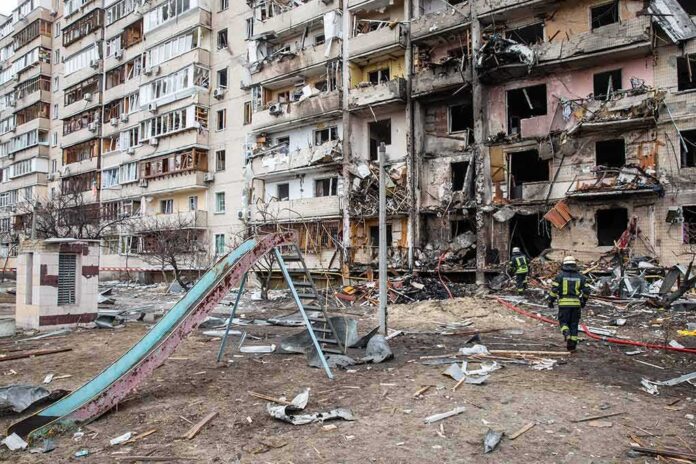
Ukrainian authorities described a scene of fires, broken glass, and debris across multiple districts as morning came. Kyiv’s police and city government reported strikes or falling debris in at least six districts, including Desnianskyi, Dniprovskyi, Solomianskyi, Sviatoshynskyi, Shevchenkivskyi, and other areas of the capital. Mayor Vitali Klitschko said a student dormitory, a residential block, a supermarket, warehouses, and other non-residential buildings were damaged or burned, with parked cars and office buildings also catching fire as missiles and drone wreckage hit.
Weapons Used And Damage To Civilian Infrastructure
Reports from the Ukrainian air force and independent defense analysts say the barrage included advanced Russian systems like Iskander-M ballistic missiles, hypersonic Zircon missiles, and S-300 or S-400 missiles repurposed for ground attack. The strike package also used Shahed-type and other attack drones, plus decoy drones and loitering munitions, showing a layered effort to confuse and exhaust Ukraine’s air defenses. Ukrainian forces claimed they shot down 17 to 18 missiles and 108 of the 125 drones, but enough got through to hit 10 locations and start fires in many more.
One of the most symbolic wounds was to the Lukianivska metro station, a key point on Kyiv’s green line. A missile strike badly damaged its surface entrance and internal areas, forcing trains to bypass the stop while emergency repairs began. Apartment buildings had windows blown out, stairwells scorched, and cars in their parking lots reduced to burned shells. A shopping and entertainment center, supermarket, and student housing were hit or burned, putting everyday civilian life — not just military targets — directly in the path of high-end weapons built and funded by a nuclear power.
Why This Strike Matters Beyond Ukraine
Ukrainian President Volodymyr Zelensky and the air force both called the attack one of the largest ballistic strike packages against Kyiv Oblast since 2022, saying Russia had spent days stockpiling missiles for it. Analysts noted that Russia burned through a huge share of its annual Zircon missile output in just the first 19 days of July, with this Kyiv barrage as a centerpiece. That level of firepower aimed at one city raises deeper worries that many Americans share, right and left, about who benefits from long wars driven by advanced weapons and global energy fights.
Conservatives who already distrust globalist policies and fear higher energy prices can see this attack as proof that Europe’s security remains shaky, which can ripple into oil markets and defense spending that Washington elites rarely explain in plain terms. Liberals who worry about growing inequality and civilian suffering see regular missile strikes on cities like Kyiv as another sign that the gap between powerful states and ordinary families keeps widening as wars drag on. Both sides ask whether governments are more focused on military posturing and defense contracts than on calming conflicts and protecting everyday people.
Escalation Risks And The Strain On Ordinary Citizens
July’s pattern in Ukraine suggests the July 19 strike was not a one-off but part of a broader surge. Analysts tracking missile use say Russia launched more than a hundred ballistic missiles in the first weeks of July, with several large salvos against Kyiv and other cities. In earlier and later strikes, dozens of people were killed and hundreds injured across multiple locations, showing how quickly casualty counts rise when even a fraction of missiles get through air defenses. For Kyiv residents, this means nights spent in shelters, damaged jobs and homes, and children growing up under sirens instead of normal peace.
A hell of a night in Kyiv.
At least 9 people were killed and 23 injured as a result of Russia’s barbaric attack with three dozen ballistic missiles. The second such massive strike in just two days.
Failing to achieve its goals on the battlefield, Russia is intensifying its air… pic.twitter.com/oZ7pgWSgR0
— Andrii Sybiha 🇺🇦 (@andrii_sybiha) August 1, 2026
Scenes from the July 19 attack — firefighters climbing a torn apartment block, metro staff rerouting trains, families sweeping glass from their kitchens — capture a human cost that is easy for far-off leaders to treat as numbers. Many Americans who already feel their own government ignores their daily struggles see echoes here: ordinary people absorbing the hit, while powerful figures talk about “packages” and “salvos.” The strike on Kyiv is not just another foreign headline; it is a warning of what happens when high-tech warfare and geopolitical games outrun real care for human lives.
Sources:
youtube.com, aljazeera.com, theguardian.com, nytimes.com, reuters.com, cnbc.com, facebook.com, apnews.com, kyivindependent.com, instagram.com, aa.com.tr
© patriotspotlight.org 2026. All rights reserved.