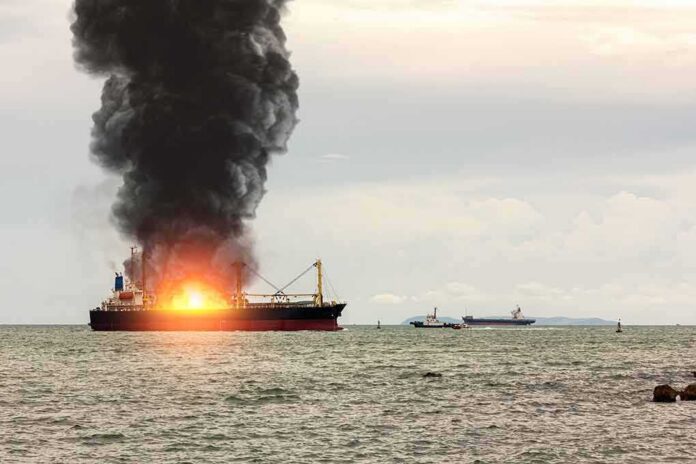
U.S. Central Command says an American aircraft fired missiles that disabled a commercial oil tanker heading toward Iran’s Kharg Island, pushing the Gulf shipping crisis into a riskier phase.
Story Snapshot
- U.S. forces say they disabled the Curaçao-flagged Belma after warnings near Kharg Island.
- Iranian officials claim the same tanker was hit again while docked at Kharg Island.
- Major outlets report the ship was unladen and struck in international waters.
- Key details like vessel registry data and damage surveys are not public yet.
What U.S. commanders say happened near Kharg Island
U.S. Central Command reported that the commercial tanker Belma ignored multiple warnings while transiting international waters toward Iran’s Kharg Island. Command officials said a U.S. aircraft fired Hellfire missiles into the ship’s smokestack or engine area to disable it. The military framed the action as blockade enforcement against a non-compliant vessel, and described the tanker as unladen at the time. Media accounts by NPR and the BBC echoed these points based on Central Command’s statements.
Bloomberg described the Belma as linked to U.S. sanctions and said the strike took place deep within the Persian Gulf. People’s Daily’s English edition repeated that the vessel was heading toward Kharg Island and did not heed warnings. These details align with Central Command’s account of a focused disabling strike rather than a broad attack on port infrastructure. The emphasis on warnings and the unladen status suggests a planned show of control over maritime flows near the island.
How Iranian sources describe the strikes
Iran International, citing a deputy governor in Bushehr province, said an empty oil tanker identified as Belma was docked at Kharg Island and came under U.S. missile fire again days after an earlier hit. Middle East Eye relayed a similar claim via the Fars outlet, which said two U.S. missiles struck the Belma N.I.22 after a prior incident. These accounts differ from the U.S. version on location and timing and suggest repeat strikes on the same ship.
Reuters coverage across the period noted overlapping claims during wider U.S.–Iran maritime escalation. One Reuters update stated the U.S. military said it hit a commercial vessel headed toward Kharg Island, while other dispatches tracked explosions reported near the island and broader attacks that slowed tanker traffic. Together, these reports place the event within a tense, fast-moving information space where both sides shape how enforcement and attacks are understood.
What we know, what is missing, and why it matters
Reporters cited named sources and official statements, but several items remain unclear. Public records do not include the vessel’s International Maritime Organization number, ownership chain, or a hull damage survey. There is no independent satellite damage analysis or insurer report available in the cited coverage. That gap makes it hard to verify whether the ship was hit offshore while moving, at anchor, or at the pier, and whether there were one or two distinct strikes.
US forces struck three Iranian oil tankers on Saturday, including one near Iran’s key oil export hub of Kharg Island.
The strikes came after the IRGC launched ballistic missiles at two US Navy warships, according to US Central Command. Iranian media reported no casualties in the… pic.twitter.com/NvYCb1DYJj
— TRT Afrika (@trtafrika) September 6, 2026
This confusion feeds wider public concern. Many Americans across the political spectrum feel leaders play power games while families pay higher prices. Kharg Island ties to global oil flows, and any strike near it can nudge energy costs up. Conservatives see risk from endless wars and shaky supply lines. Liberals see risk to civilian shipping and regional stability. Both see a system that keeps secrets, with few hard records on what was hit, where, and why, even as markets and families face the bill.
Sources:
npr.org, bbc.com, nytimes.com, en.people.cn
© patriotspotlight.org 2026. All rights reserved.