

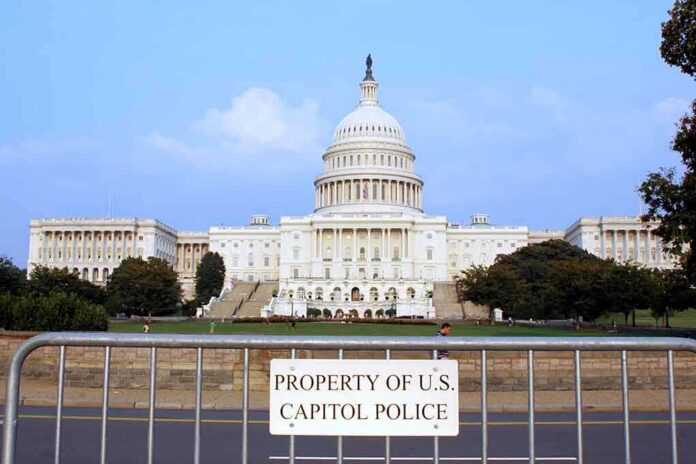
President Trump has left the federal agency that helps states run elections without leadership just months before the midterms.
Quick Take
- The White House dismissed the last three members of the Election Assistance Commission, a bipartisan agency created to help states administer elections.
- The agency helps certify voting systems, share election guidance, and distribute grant money to states.
- Critics say the timing raises fears about political pressure on election support ahead of the 2026 vote.
- The administration has legal backing from a recent Supreme Court ruling that expanded presidential removal power over some independent agencies.
What the firings changed
The Election Assistance Commission lost its remaining commissioners after the White House removed Thomas Hicks, Benjamin Hovland, and Christy McCormick. Reporters said the action came with only months left before the midterm elections. The agency was created in 2002 under the Help America Vote Act and was designed to stay bipartisan, with no more than two commissioners from the same party.
The EAC is not the body that runs elections, but it does matter to how states prepare for them. It serves as a national clearinghouse for election information, accredits testing labs, certifies voting systems, and maintains the federal mail voter registration form. Just Security said staff can still carry out some grant work and certification tasks, but the commission itself needs commissioners to conduct official business.
Why critics see a power grab
Democrats and voting rights advocates called the firings a warning sign because they hit a bipartisan agency during active election planning. NPR reported that the removals left the agency unable to carry out its major responsibilities, while the Brennan Center said it was left without leadership. Those critics see a broader pattern of presidential pressure on independent boards, especially after the Supreme Court expanded removal power in Trump v. Slaughter.
The legal fight matters because the Court’s ruling gave the president broad room to remove commissioners without showing cause. That makes the EAC dispute more than a staffing change. It shows how fast a president can reshape agencies that were once built to stand apart from the White House.
What the administration says
The White House has pointed to that same legal shift as support for the removals. Reuters reported that the 2002 law creating the EAC allows the president to appoint replacements, which means the agency will not stay leaderless forever. But new commissioners still need Senate confirmation, and the process can take time.
Yes, so firing them accomplished what Trump wanted, no ability to certify voting systems, distribute grants or update federal forms. The EAC was explicitly structured as an independent agency to prevent any single administration from exerting partisan control over voting…
— LAHatx (@LAHTX33) July 11, 2026
That delay is why the episode matters beyond Washington procedure. Election officials depend on steady guidance, grant flows, and clear rules long before ballots are cast. When a small but important agency is emptied out right before a major vote, both sides of the political divide tend to ask the same question: who benefits from a weaker guardrail system?
Sources:
feedpress.me, democracydocket.com, politico.com, reddit.com, npr.org, facebook.com, pbs.org, pacificlegal.org, supremecourt.gov
© patriotspotlight.org 2026. All rights reserved.