

America’s first carrier-based refueling drone is now running about five years late, raising hard questions about what went wrong and who is being held accountable.
Story Snapshot
- The Navy’s MQ-25 Stingray drone is now expected to be operational around 2029, roughly five years behind its original 2024 goal.
- Officials blame testing time, supplier quality problems, and production “maturity” issues, while watchdogs warn about building jets before they are fully proven.
- The program has hit key milestones like first flight and production approval, yet its schedule keeps slipping in budget documents.
- The delays mean carrier air wings must rely longer on older aircraft and shorter ranges, even as taxpayers fund a $15–16 billion program.
What the MQ-25 Was Supposed to Do—and When
The Boeing MQ-25 Stingray is meant to be the Navy’s first carrier-based refueling drone, designed to extend the range of fighter jets launched from aircraft carriers. Early plans called for the first four aircraft to be ready by August 2024, with Initial Operational Capability, or IOC, set around 2024–2025. In simple terms, IOC means at least a small number of aircraft, crew, and gear are ready to deploy on a carrier for real-world missions.
Budget documents and reporting show that original 2024 IOC date did not hold. Navy acquisition records say the IOC estimate moved from August 2024 to September 2025 because building test aircraft took longer than planned. Those delays flowed from design choices, supplier problems, and slower-than-expected assembly of Engineering Development Model jets, which then pushed back when test teams could start full flight trials. Already, the tanker drone was slipping while still on paper as a “must-have” future tool for the fleet.
How a One-Year Delay Turned Into Five
Navy officials first tried to present the schedule changes as limited and manageable. In 2022, program manager Captain Sam Messer said MQ-25 would reach IOC in September 2025, about six months late, due to “supplier quality issues” that slowed construction of key test aircraft. Soon after, a Navy spokeswoman told Inside Defense the service was moving IOC back a year, to 2026, to allow “sufficient time for testing” the unmanned tanker. Leaders stressed this was about safety and maturity, not about canceling the program.
Those reassurance messages did not stop the clock from slipping again. Aviation Week reported that budget documents later pushed IOC another ten months to mid-2026. Rear Admiral Stephen Tedford, who oversees unmanned aviation, said production delays and “production maturity challenges” forced the Navy to move IOC from 2025 to 2026. Outside watchdogs also raised alarms. The Department of Defense Office of Inspector General warned that building too many jets before testing could backfire and raise costs and deployment delays. In response, the Navy slowed decisions on low-rate production to line up better with test results.
First Flight and Milestone C: Progress Without Readiness
Supporters of the program point to recent milestones as proof the MQ-25 is not dead weight. The first flight of a production-representative MQ-25 took place in April 2026, marking the start of formal testing for the operational design. Images and reports described a two-hour flight from MidAmerica Airport in Illinois, with the aircraft using its own systems rather than earlier demonstrator hardware. This was a key step toward getting real data on how the drone handles takeoffs, landings, and fuel transfers for carrier operations.
On the acquisition side, the Navy has also moved the program into Low-Rate Initial Production. Reporting says MQ-25 received Milestone C approval, which allows the service to start buying limited numbers of aircraft while testing continues. The plan calls for a total of 76 air vehicles, with an estimated program cost around $15.9 billion. For defenders of the Navy’s approach, these moves prove the program is active and building hardware, not stuck in a lab. But for critics on both the right and the left, the question is why so much money is flowing while the promised capability stays years away.
IOC Now Slipping to 2029—and What That Means
Recent budget documents and follow-up reporting show the schedule has stretched far beyond the original 2024 target. Inside Defense reported that in the Fiscal Year 2026 plan, MQ-25 was projected to reach IOC in the third quarter of Fiscal Year 2027, only to be moved again to the second quarter of Fiscal Year 2029. Other summaries say the latest projection for MQ-25 IOC is February 2029, and note the program “continues to look for opportunities to mitigate additional schedule risk.” Taken together, these updates mean IOC is now about five years late versus the first 2024 promise.
Boeing unmanned platform, MQ-25 Stingray and MQ-28 Ghostbat pic.twitter.com/RGvTWvNp4Y
— Keane Rara (@GardaAramis) July 18, 2026
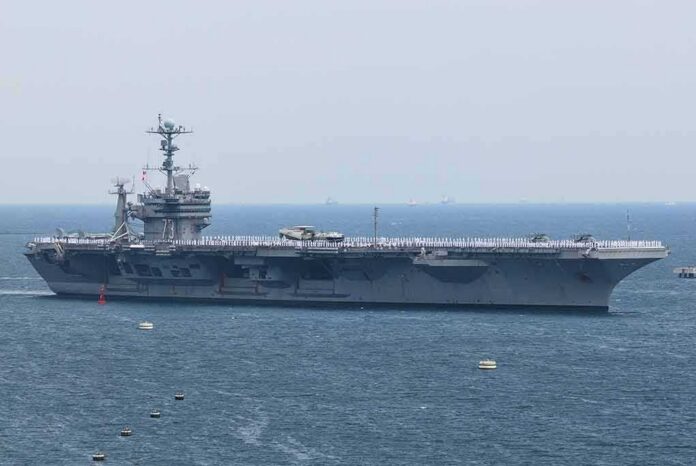
The delay does more than embarrass the Navy or Boeing. Carrier air wings were counting on MQ-25 to let fighters take off with heavier weapons loads and less fuel, then refuel from the drone once airborne. Scramble reported that initial MQ-25 deployments on the carrier USS Theodore Roosevelt have been pushed to 2029 because both aircraft production and carrier availability fell behind. Until MQ-25 arrives, older aircraft must keep flying the refueling mission, which can limit strike range and raise maintenance and manpower demands.
Why This Fits a Bigger Pattern That Frustrates Voters
The MQ-25 story looks familiar to anyone watching federal programs. A system is sold as vital to national security. A winning contractor gets a big fixed-price deal. Deadlines slip from 2024 to 2025, then to 2026, 2027, and now 2029, while official language stays vague about who is at fault. Budget documents talk about “mitigating schedule risk” but do not show taxpayers the hard data on test failures, supplier defects, or management missteps. For many Americans, this feels like one more example of elites managing narratives instead of delivering results.
Conservatives see bloated defense spending, slow delivery, and weak accountability. Liberals see large contracts for big companies while basic needs at home struggle. Both sides watch a drone tanker that was supposed to be ready years ago still waiting on the flight deck, and they wonder if anyone in Washington loses their job when billion-dollar promises slip by half a decade. The MQ-25 delays do not prove the program has no value. But they do reinforce a wider fear: the federal government can write plans and press releases faster than it can turn ideas into working tools that protect the country.
Sources:
insidedefense.com, zona-militar.com, aerospaceglobalnews.com, scramble.nl, aviationweek.com, defensedaily.com, news.usni.org, linkedin.com, blog.naver.com
© patriotspotlight.org 2026. All rights reserved.