

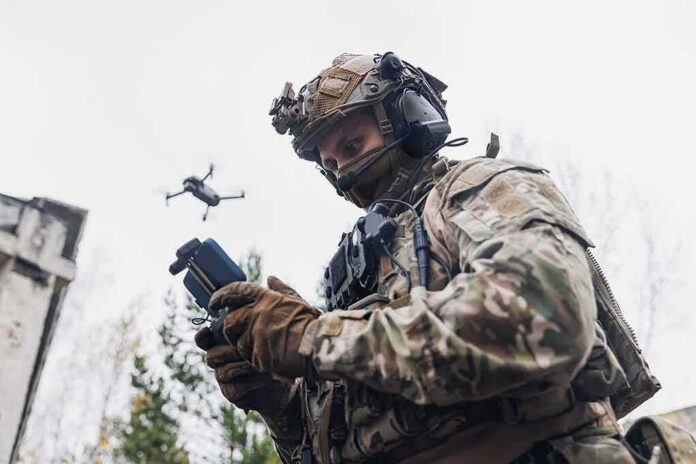
Ukraine’s embrace of cheap, smart drones has turned a once top‑down, old‑school army into one of the most disruptive fighting forces of the modern age, exposing how slow, elite‑run militaries can fail their own troops when they ignore new technology.
Story Snapshot
- Ukraine now produces millions of drones a year and has built a fast, flexible wartime tech industry around them.
- Commanders have woven drones into nearly every part of combat, from frontline scouting to deep strikes against Russian fuel and rail lines.
- Analysts say this drone “ecosystem” helps offset Russia’s larger army and shows how bottom‑up innovation can beat rigid old doctrines.
- Experts warn other countries not to copy the tech without the training, leadership changes, and honest learning that made it work.
Ukraine’s Drone Surge and a Shift in Military Culture
Since Russia’s full invasion, Ukrainian leaders have pushed drones from the margins to the center of their war effort, reshaping how decisions are made on the battlefield. Early in the war, Ukraine used a handful of military drones and hobby models, often as quick fixes when artillery and jets were scarce. By 2024, the Ministry of Defense had delivered over 1.2 million drones of many types, from small quadcopters to deep‑strike aircraft. This scale forced older commanders to accept that real‑time video and digital maps, not paper orders and gut instinct, now guide combat.
Reports describe how the armed forces of Ukraine built what one analyst calls a “drone‑centric” strategy, where unmanned systems are assumed in nearly every plan. Command posts now rely on swarms of small drones to find targets, watch Russian movements, and check damage after strikes. Younger officers and civilian tech teams help tune tactics day by day, creating feedback loops that move faster than traditional chains of command. That change has been hard on some older leaders, but battlefield results have given reformers leverage to keep pushing.
From Factory Floor to Front Line: A Wartime Drone Ecosystem
Ukraine’s drone revolution is not just about gadgets; it rests on an entire wartime economy that turns ideas into hardware in months, not years. Before the war, the country had only a handful of domestic drone makers. Within a year, that grew from seven firms to at least eighty, backed by public‑private partnerships and a mix of state money, volunteer cash, and tech talent. By 2024, officials say Ukraine delivered more than 2 million drones, and analysts expect output to reach around 4 to 5 million systems in 2025.
Factories and small workshops now build everything from palm‑sized First‑Person View racing drones to larger strike platforms that can hit fuel depots hundreds of miles away. Many designs borrow parts from consumer devices or 3D‑printed frames, keeping costs low and making it harder for Russia to choke supply chains. A key point for frustrated American readers is that Ukraine did this under extreme pressure, cutting red tape and letting engineers, soldiers, and local companies work together instead of waiting for distant bureaucrats. That stands in sharp contrast to slow, elite‑run defense systems in many Western capitals.
Drones on the Battlefield: Tactical Edge, Strategic Limits
On the front lines, drones now handle scouting, artillery spotting, direct strikes, logistics, and even casualty evacuation, creating what some call a new kind of “reconnaissance‑strike” complex. Small quadcopters send live video to tablet screens, letting units adjust fire within seconds rather than minutes. Cheap FPV drones slam into tanks and bunkers, trading a few hundred dollars of hardware for the destruction of far more expensive Russian equipment. Unmanned ground vehicles carry ammo and food through kill zones, and Ukrainian planners aim to move “up to 100% of frontline logistics to robotic solutions.”
Medium‑ and long‑range drones reach far beyond trenches, striking Russian oil refineries, bridges, and rail hubs to choke supply lines and cut fuel flows. One study notes that more than 7,000 long‑range drones hit Russian energy sites in a single month, helping slash export capacity by about 40 percent. Another reports drone‑led operations that destroyed bombers on the ground and retook dozens of square miles in a few days. These successes excite both conservatives who want lean, effective power and liberals who worry about wasteful, slow wars driven by outdated thinking.
Old Lessons, New Machines: Why Institutions Still Matter
Despite the hype, serious military scholars warn drones alone did not magically solve the war, and copying Ukraine’s gadgets without its learning could be dangerous. The Modern War Institute at West Point notes that drones, while deadly, have brought “limited strategic effect” so far, helping create static, grinding battles instead of swift maneuvers. Analysts stress that Ukraine’s gains come from pairing drones with better training, smarter targeting, and tighter coordination, not simply buying more machines.
That warning points back to a core worry many Americans share: technology can mask deeper failures if leaders refuse to change how they plan, spend, and lead. Ukraine’s experience shows that when a government lets local innovators, mid‑level officers, and ordinary citizens shape wartime tools, it can move faster than huge, elite‑run systems that cling to old habits. For both right and left, the message is clear. New hardware matters, but honest learning, flexible command, and respect for the people doing the fighting matter even more—and those are exactly the areas where many feel their own government has fallen behind.
Sources:
youtube.com, lse.ac.uk, hudson.org, mwi.westpoint.edu, atlanticcouncil.org, understandingwar.org, icds.ee, bloomberg.com, irregularwarfarecenter.org, en.wikipedia.org
© patriotspotlight.org 2026. All rights reserved.