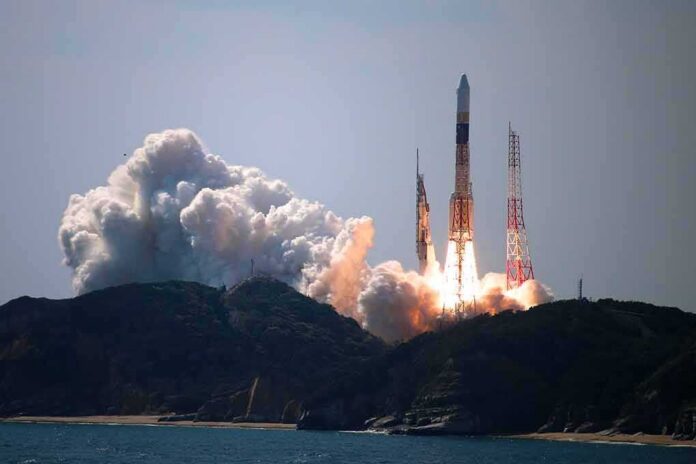
South Korea’s homegrown Nuri rocket lifted off on time and carried 15 satellites toward a sun-synchronous orbit, signaling a major step in the country’s push to build and launch its own satellite networks.
Story Highlights
- Nuri launched from Naro Space Center at 12:25 p.m. local time on Oct. 7.
- The payload included five NEONSAT microsatellites and 10 CubeSats.
- This was Nuri’s fifth mission and a program milestone for constellation work.
- Reports tied details to Korea AeroSpace Administration and Korea Aerospace Research Institute.
What Happened at the Pad and in Flight
South Korea launched its Nuri rocket from the Naro Space Center in Goheung at 12:25 p.m. local time on October 7. Reports described a clean liftoff from the second launch pad and a flight profile targeting a sun-synchronous orbit near 575 kilometers. Coverage said the mission carried 15 satellites. Those included five New-space Earth Observation Satellite Constellation for National Safety microsatellites and 10 CubeSats. Officials and outlets credited the Korea AeroSpace Administration and the Korea Aerospace Research Institute for mission details.
Outlets reported the mission aimed to place the payload into a sun-synchronous orbit about 575 kilometers above Earth. That orbit type lets satellites pass over the same parts of the planet at similar local times. Aju Press said Nuri launched carrying 15 satellites, while Korea Herald described the sun-synchronous target. Together, those details show a clear mission plan and a payload designed for frequent imaging and data collection over Korea and nearby regions.
Why the Payload Mix Matters
The manifest matters because it blends national safety goals with industry growth. The five NEONSAT microsatellites form part of South Korea’s first domestically launched microsatellite constellation, according to wire reporting tied to agency briefings. The 10 CubeSats expand training, testing, and services for schools, labs, and startups. Aju Press reported a payload mass around 1,071 kilograms in pre-launch coverage, marking Nuri’s heaviest load and a stress test for sequential deployments.
Sequential deployment is a big step for any launch program. Pre-mission briefings described satellites releasing in short intervals, which reduces collision risk and helps spread out orbits for coverage. South Korea’s agencies framed this fifth flight as a milestone for that exact skill. Yonhap and other outlets linked those claims to the Korea AeroSpace Administration and the Korea Aerospace Research Institute, grounding the story in official program sources rather than rumor or hype.
How This Fits South Korea’s Space Strategy
This launch sits inside a larger plan to move from single payloads to full networks. Recent reporting showed South Korea backing public-private roles, with industry partners taking on more operations as the government sets standards and goals. Multiple outlets called this flight the fifth Nuri mission and the first try at a domestically launched microsatellite constellation. That framing matches South Korea’s push to build a stable, repeatable space supply chain at home.
South Korea's Nuri rocket (KSLV-II) lifted off on time at 12:25 p.m. Korea Standard Time on Wednesday, October 7, reached about 575 kilometers altitude and separated all 15 payload satellites, the Korea AeroSpace Administration and Korea Aerospace Research Institute said.
It was… pic.twitter.com/xLzc9lNZCN
— 2logics (@2logics) October 7, 2026
Past flights set the stage for today’s result. Earlier missions built confidence in engines, staging, and guidance. At the same time, coverage has reminded readers that spaceflight success is not just liftoff. The goal is clean deployment to the planned orbit. Today’s reports point to that outcome, but agencies often share more technical detail after the flight. For now, the clear facts are the liftoff time, the 15-satellite payload, the orbit target, and the program milestone of Nuri’s fifth mission.
Sources:
youtube.com, en.yna.co.kr, chosun.com, news.sbs.co.kr, en.sedaily.com, ajupress.com
© patriotspotlight.org 2026. All rights reserved.