

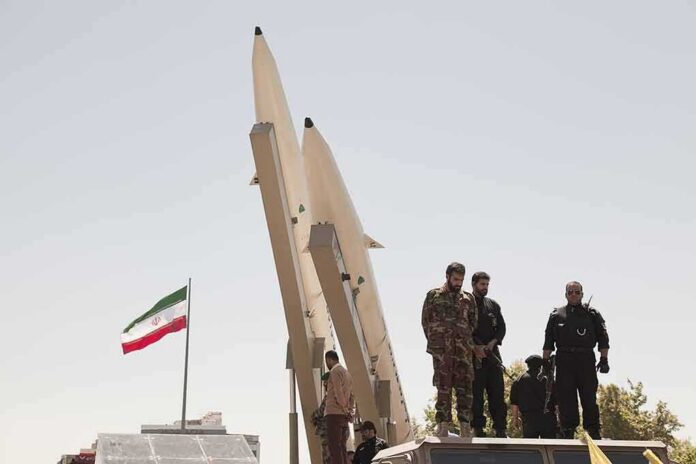
President Trump said the U.S.-Iran conflict will end “very soon” and blasted Ukraine’s Volodymyr Zelenskyy, staking big claims that energize supporters and alarm skeptics.
Story Highlights
- Trump vowed Iran will not get a nuclear weapon and said strikes gutted key sites.
- Arms-control experts say Iran kept materials and capability despite damage.
- Trump called Zelenskyy harder to deal with than Vladimir Putin and blamed him for the war’s course.
- Reuters notes Russia started the war by invading Ukraine’s territory.
What Trump Claimed About Iran and Ukraine
President Trump said Iran “will never have a nuclear weapon under us” and predicted the U.S.-Iran conflict would end “very soon.” He described past strikes that he said buried or destroyed Iranian nuclear sites. He also attacked Ukrainian President Volodymyr Zelenskyy, calling him tougher to work with than Russia’s Vladimir Putin, and faulted Kyiv’s leadership for the war’s course. These claims came in a friendly interview setting that offered little pushback at the time.
Trump’s words land in a tense moment. Many Americans on the right fear endless wars, high costs, and weak borders. Many on the left fear strongman politics, cuts to safety nets, and widening inequality. A growing share across both camps believes powerful insiders protect their own interests first. Bold promises about fast endings and absolute outcomes speak to that frustration. But they also demand proof that stands outside politics and media spin.
What Independent Analysts Say About Iran’s Nuclear Program
The Arms Control Association reported that U.S. and Israeli strikes caused heavy damage to Iranian nuclear facilities but did not erase Iran’s ability to rebuild key parts of its program. The group said Iran kept important materials and capacity even after the attacks. A Chatham House analyst wrote that claims of a one-to-two-year setback are hard to verify because international inspectors have had limited access, and the exact location of some nuclear materials is still unclear.
The Foundation for Defense of Democracies said the International Atomic Energy Agency could not verify the status of hit sites or related nuclear material without broader access. These assessments do not prove Iran is building a bomb, and they do not say strikes did nothing. They show a middle ground: damage is real, but the final effect on Iran’s long-term capability remains uncertain without inspections and data.
Fact-Checking Claims About Zelenskyy and the War’s Start
Trump argued that President Zelenskyy shares blame for the war, saying he should have prevented it. Reuters documented that Russia began the full-scale conflict by invading Ukraine’s sovereign territory in 2022, which contradicts the idea that Ukraine “started” the war. That timeline matters. It shapes who bears legal and moral responsibility for crossing borders and using force. It also shapes how allies, sanctions, and aid packages are debated in Congress and abroad.
Trump’s sharper tone toward Zelenskyy reflects deep fatigue among many Americans about open-ended support and unclear endgames. Critics of more aid point to high costs and the risk of escalation. Supporters argue that pulling back rewards aggression and invites more instability. Both sides share a core fear: leaders in Washington talk past the public and hide the bill until later.
Numbers, Timelines, and the Public’s Trust
Large round numbers and short timelines make big headlines. They are easy to remember and repeat. But they can also outpace verification. Analysts have challenged past claims about total U.S. support to Ukraine that combined different types of assistance into one sum without clear accounting. Predicting that a conflict will end “very soon” raises hopes but needs dates, steps, and named channels to be measured later. Without that, voters are left with applause lines, not checkable plans.
For citizens who feel the system serves elites first, these disputes fuel a larger concern: Are leaders being straight with the public about cost, risk, and trade-offs? Clear proof would help. On Iran, that means inspection access and shared evidence about facilities, materials, and timelines. On Ukraine, that means transparent ledgers that separate weapons transfers, cash, replenishment, and humanitarian aid. Accountability is not partisan. It is how a free people keep faith with their own values.
Sources:
economictimes.indiatimes.com, kennedy.byu.edu, pbs.org, apnews.com, verfassungsblog.de
© patriotspotlight.org 2026. All rights reserved.