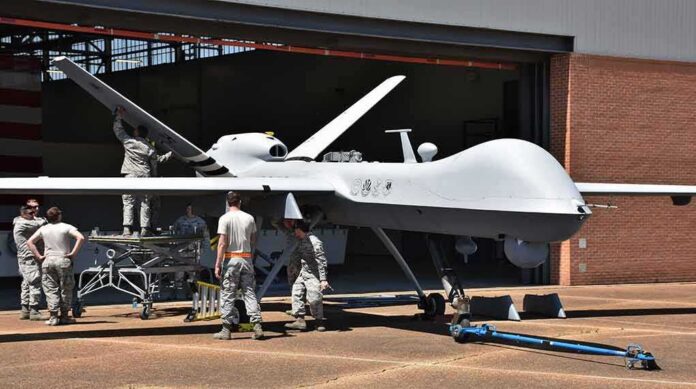
The U.S. Army’s McAlester Army Ammunition Plant will load warheads for a new line of attack drones built by Perennial Autonomy, a company backed by former Google chief Eric Schmidt.
Story Highlights
- Army plant in Oklahoma joins with Perennial Autonomy to arm battlefield drones.
- McAlester will manufacture and load explosive payloads, then deliver them for drone use.
- Move fits a wider push to modernize aging plants for drones and munitions production.
- Officials did not release contract terms, quantities, or delivery timelines.
Army Facility Shifts From Bombs To Drone Warheads
Army leaders marked the partnership at a ribbon-cutting at McAlester Army Ammunition Plant in McAlester, Oklahoma. The Army described the deal as a “transformative defense production partnership” with Perennial Autonomy, a firm that builds drones for battlefield use. McAlester’s core mission is to receive, store, ship, produce, renovate, and demilitarize ammunition. The site also runs “load, assemble, pack” lines for bombs, projectiles, and warheads, which fits this new tasking.
Defense reporting says McAlester will manufacture and load explosive payloads for Perennial’s drone fleet, then deliver those munitions for use in combat systems. That means the government facility handles the sensitive warhead work while the company provides airframes and guidance. The arrangement reflects a public-private model the Army uses across ammunition plants. The government owns the site. Industry brings designs, tooling, and speed to scale production.
Why This Partnership Matters For U.S. Production
The Army has pushed to refresh an aging industrial base after high demand for shells, rockets, and small drones. Leaders have announced new investments to lift artillery output and modernize production lines at other plants as well. McAlester’s partnership with Perennial fits that shift. It turns legacy lines built for large bombs into flexible cells that can arm small, expendable drones at scale. That helps the military respond faster to new threats.
Public materials often describe these deals in broad terms. Officials highlight capabilities and goals but rarely list contract vehicles, unit counts, or delivery dates. McAlester’s announcement followed that pattern. The Army confirmed the partnership and its purpose but did not release detailed schedules or quantities. That limits outside tracking of cost and pace but is common for industrial base moves that touch sensitive munitions work.
How It Fits Today’s Drone-Heavy Battlefields
Modern wars have shown how cheap drones and tailored warheads can strike armor, air defenses, and supply lines. The Army’s approach now treats many small drones more like ammunition than aircraft. They are low-cost, mass-produced, and meant to be used up in combat. Placing warhead production inside an Army plant helps manage safety, storage, and shipping while keeping supply closer to commanders’ needs.
The airframe came from a 2023 startup. The warhead comes from Oklahoma.
McAlester will load payloads for Perennial's drones. The plant already has the chemists and the load-assemble-pack crews, and the Army says partnerships like this one help pay for its infrastructure…
— Tate Williams (@Tate_Williams86) October 6, 2026
McAlester has done explosive work since World War II. The plant’s role includes building and loading bombs and other munitions for the Department of Defense. The site’s “load, assemble, pack” capability is central to its mission. That makes it a natural node to arm new classes of drones without standing up a brand-new factory. It also keeps warhead handling under strict government safety and oversight standards.
The Politics And The Principle At Stake
Supporters will see this as a practical win: use what America already has to move faster than its rivals. Critics will worry that private tech money and public plants now mix on more lethal systems. Both views speak to a shared concern. Americans want a defense supply chain that is strong, accountable, and not captured by any one set of elites. Clear performance goals and transparent oversight can help this partnership earn that trust.
What We Still Do Not Know
The Army and Perennial have not shared how many drones will be armed at McAlester, when deliveries begin, or the exact munitions types. They also have not outlined how surges would work if a crisis demands more output. These gaps are typical in early industrial base moves. Lawmakers and the public often learn more as production ramps and budget lines appear in formal documents and hearings.
Bottom Line
McAlester’s new role arming Perennial’s drones shows how the United States is rewiring old plants for new wars. The government keeps control of explosives work. The company brings rapid drone design. If the partnership delivers safe, steady output, troops get more options in the field. The test now is speed, cost, and accountability—delivering warheads at scale without wasting dollars or hiding the ball from the people footing the bill.
Sources:
zerohedge.com, army.mil, defensecommunities.org, einpresswire.com, 163.com, oklahoma.gov, aschq.army.mil, mcaap.army.mil
© patriotspotlight.org 2026. All rights reserved.