

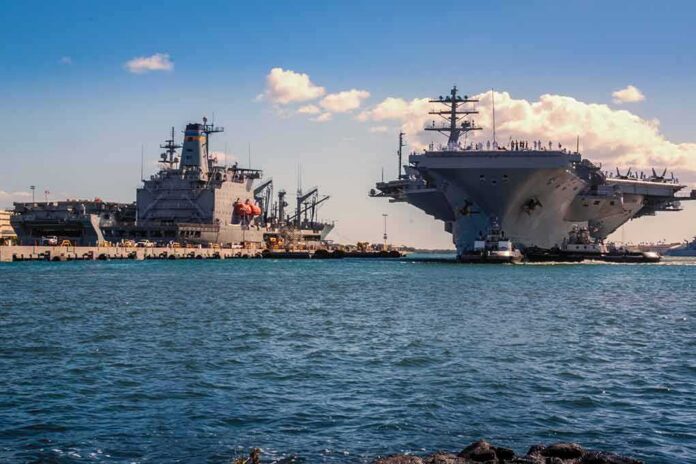
After 265 straight days at sea without a port call, the USS Abraham Lincoln finally came home to San Diego.
Story Highlights
- The carrier returned after a roughly 10-month deployment tied to war operations near Iran.
- Sailors set a modern Navy record with 265 consecutive days at sea without a port visit.
- Total time away ran about 321–322 days, among the longest since the Cold War ended.
- Navy leaders acknowledged severe strain during the mission, including eight suicide attempts.
Record Homecoming After Extended War Deployment
Reporters watched the nuclear-powered carrier enter San Diego Bay with thousands of families waiting on the pier. The return followed months of operations linked to the conflict with Iran and wider Middle East tensions, which defense leaders said drove repeated extensions. News crews captured parents meeting newborns and children seeing a parent for the first time in months, underscoring the human cost behind the deployment’s length and intensity.
Defense outlets and local media reported the ship spent 265 straight days at sea without a port call. That streak set a modern record for a United States Navy carrier, even as the overall deployment ranked as the second-longest since the Cold War. Different outlets listed the total as either 321 or 322 days, reflecting close timing but the same basic fact: this was an unusually long mission for a modern carrier strike group.
Leadership Acknowledges Extensions And Crew Strain
Defense Secretary Pete Hegseth told sailors he had twice signed orders to extend the cruise, and he thanked the crew for carrying out a hard job before they stepped ashore. During coverage of the return, officials and reporters also noted severe stress across the strike group. The Navy confirmed eight suicide attempts during the deployment, a stark measure of strain that added urgency to calls for better support after long missions.
Central Command leaders and major outlets described the deployment as unusually intense. The carrier supported combat and deterrence tasks tied to the Iran war and regional threats. Long, unpredictable orders have become more common as global hotspots grow. That tempo has stretched families, equipment, and morale while testing the Navy’s ability to keep a steady rotation. Analysts say deployment lengths now often exceed the service’s seven-month goal.
Why This Matters Beyond One Ship
The Lincoln’s homecoming shows how national security choices land on working families. When deployments run many months beyond plan, spouses shoulder childcare alone, savings get tighter, and mental health risks rise. Those facts cut across ideology. Conservatives see overstretch as proof the fleet is too small. Liberals see strain as proof people in uniform pay the price when policy leans on force. Both sides see a system that asks more than it plans to support.
The USS Abraham Lincoln returns to San Diego after a 321-day deployment, one of the longest U.S. aircraft carrier deployments since the Vietnam War, setting the stage for heartfelt reunions between sailors and their waiting families. pic.twitter.com/qIcnoPYlvZ
— QThestorm RV🦅🇺🇲 (@17QStorm6RV) October 9, 2026
The Navy and elected leaders now face a clear test. If long deployments will be the norm, the nation must size the fleet, repair parts pipelines, and fund mental health care to match. If not, leaders must explain how they will cut tempos without risking missions. Either path needs straight answers, steady resources, and less spin. The sailors did their job for nearly a year. The country owes them clarity about what comes next.
Sources:
zerohedge.com, apnews.com, ocregister.com, fox35orlando.com, irishnews.com, newsnationnow.com, crow.house.gov
© patriotspotlight.org 2026. All rights reserved.