

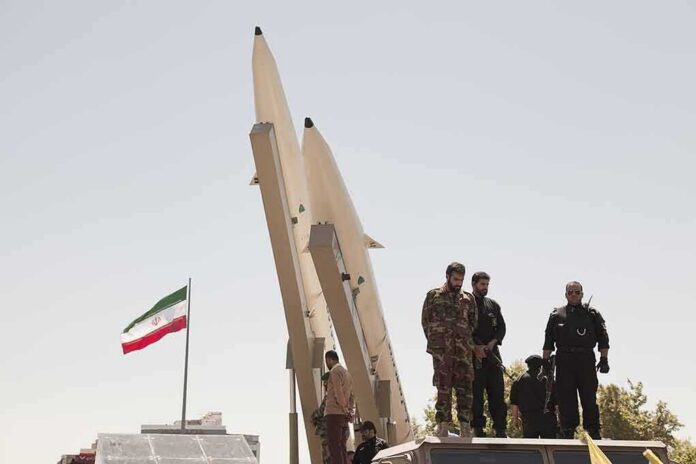
Iran’s supreme leader told top generals to prepare an “immediate and effective” strike with no geographic limits if the United States or Israel attacks again.
Story Snapshot
- Ayatollah Ali Khamenei ordered a rapid, borderless response to any renewed U.S. or Israeli strike.
- The directive went to Iran’s top three military chiefs, not just the public.
- State-linked outlets echoed the “without geographical limitations” language.
- Commanders were told to expand retaliation targets across American and Israeli assets.
What Khamenei Ordered And To Whom
On October 31, Iran’s supreme leader, Ayatollah Ali Khamenei, issued new instructions to senior military leaders. He told them to deliver an “immediate and effective response” to any renewed U.S. or Israeli attack, “without geographical limitations.” Axios reported that the message went to the heads of the Islamic Revolutionary Guard Corps, the Army, and the General Staff of the Armed Forces. Bloomberg matched those recipients and framed it as clear guidance to Iran’s command tier.
Iranian state-linked outlets carried similar wording. Newsweek reported that Iran’s official news agency conveyed an order to respond to “any kind and level of threat,” while the outlet tied to the Islamic Revolutionary Guard Corps used the phrase “without geographical limitations.” These reports reduce doubt about what was said, even if they rely on Iranian sources. The message was not only a public warning; it was addressed to those who plan and execute military moves.
Target Bank Expansion And Control Of Hostilities
The directive included a concrete task for planners: update the “target bank.” Khamenei’s office, as reported by Axios, said the list should ensure all “material and non-material assets” of the “American-Zionist” enemy are within reach. He also stated that if hostilities resume, Iran will decide when and under what conditions they end. This language signals broader options for cyber, economic, and military targets, and asserts control of escalation timing.
Bloomberg added that the order aims to expand options for retaliation, while diplomacy also continued in parallel. That mix—deterrent threats and diplomatic outreach—matches how Iran has often tried to shape risk for opponents. It attempts to warn Washington and Jerusalem while keeping channels open. Associated Press likewise highlighted the unusual “no geographic limits” phrasing, which suggests possible targets outside the immediate region if conflict returns.
Why This Fits Iran’s Deterrence Playbook
Iran has long used strong retaliatory language to offset weaker conventional air power. Analysts describe how Tehran leans on missiles, cyber tools, and partners to impose costs far from its borders. That pattern grew from hard lessons in the Iran–Iraq War and later confrontations. A Congressional Research Service paper notes that Iran has often answered strikes by hitting what it sees as analogous targets, climbing an “escalation ladder” rather than absorbing blows without reply.
Scholars also explain how Iran’s missile and proxy strategy aims to deter stronger foes by raising risks they cannot ignore. This approach tries to force caution in Washington and Jerusalem without inviting a full-scale war. The current order’s “without geographical limitations” line fits that logic. It hints at reach, not just in the Gulf, but wherever Iran assesses leverage, while avoiding public details on units, timelines, or exact targets.
What We Know And What Is Not Shown
The reporting establishes a clear directive, the intended audience, and core phrases that match across several outlets. It does not show the full transcript, an official document number, or a completed target list. It also does not disclose force movements, weapon tasking, or readiness levels tied to the order. Those limits mean the statement shows intent and planning direction, not proven operational capacity or final rules for when a response would launch.
Iran Warns US & Israel: NOWHERE OFF LIMITS!
🇮🇷⚔️🇺🇸🇮🇱 Iran supreme leader warns US & Israel: NOWHERE is off limits if Trump & Netanyahu strike again!Published today 8:44 AM MYT — Iran warns of fresh attacks after Trump & Netanyahu threats to resume strikes after crucial…
— What You May Have Missed (@WhatYouMissed_) November 1, 2026
For Americans, the stakes are plain. A borderless response promise means U.S. assets, allies, and businesses could be named as targets in a wider arc if fighting resumes. That threatens energy routes, global trade, and digital networks. Voters across the spectrum worry that Washington’s leaders will protect their positions but not the public from blowback. This directive underscores how fast a regional spark could hit wallets, jobs, and daily life far from the battlefield.
What To Watch Next
Watch for signs that Iran actually updated its target files and moved units. Satellite imagery, air-defense alerts, naval shifts, or unusual cyber activity would show steps beyond words. Look also for follow-up remarks from the three commanders who received the order. At the same time, track diplomacy. If talks gain traction, it may cool tempers. If attacks resume, the “no limits” promise will test whether deterrence talk turns into action.
Sources:
axios.com, nilepost.co.ug, bloomberg.com, iranintl.com, bttn.org.pk
© patriotspotlight.org 2026. All rights reserved.