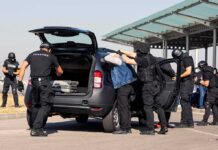
A routine visit to one of Mexico’s most famous ancient sites turned into a hostage-taking shooting spree—raising hard questions about why basic security checks were allowed to lapse.
Quick Take
- A lone gunman opened fire atop the Pyramid of the Moon at Teotihuacán, killing a Canadian tourist and injuring more than a dozen people, including children.
- Mexican authorities say the attacker, identified as 27-year-old Julio Cesar Jasso Ramírez, acted alone and died by suicide after firing more than 20 shots.
- Local guides said routine entry screenings had been discontinued in recent years, a detail now central to public scrutiny.
- Mexico’s National Institute of Anthropology and History closed the site indefinitely as the investigation continues and tourism fallout grows.
What happened at Teotihuacán—and why it shocked visitors worldwide
Mexican authorities said a 27-year-old man opened fire shortly after 11:30 a.m. Monday on top of the Pyramid of the Moon at Teotihuacán, about 30 miles northeast of Mexico City. Dozens of tourists were on the structure when shots rang out, sending people sprinting down steep stone steps. Officials reported one Canadian woman was killed and more than a dozen others were hurt, including several struck by gunfire.
Investigators said the attacker took hostages during the incident, fired more than 20 rounds, and then died by suicide. Authorities recovered a firearm along with a knife and ammunition, according to reporting that cited Mexican officials. Victims included travelers from the United States, Canada, Colombia, Russia, and Brazil, spanning a wide age range that reportedly included children. No other suspects were named, and officials characterized the attack as a lone-actor event.
Security gaps: when “open access” becomes a public-safety liability
Teotihuacán is a UNESCO World Heritage site and one of Mexico’s signature tourist draws, which makes the attack unusual not just for its violence but for its location. Local guides told reporters that routine entry screenings had been discontinued in recent years, a change that could have made it easier to bring weapons onto the grounds. The site’s open-air design and high foot traffic create real limits, but the complaint is straightforward: fewer checks can mean higher risk.
Mexico’s National Institute of Anthropology and History responded by closing Teotihuacán indefinitely, a move that signals concern about immediate safety and the need to reassess protocols. For travelers, the closure is also an economic warning light for the surrounding community, where guides and small businesses rely on steady tourism. For governments, it’s a test of competence: citizens and visitors tend to accept risk they can see, but they revolt at risk that appears preventable through basic precautions.
Official messaging emphasizes “lone actor,” but questions remain about motive
Mexican officials said the attacker acted alone, and President Claudia Sheinbaum expressed solidarity with victims and pledged an investigation, including outreach to the Canadian embassy. Authorities also moved quickly to identify the shooter publicly. That “lone actor” framing matters because it pushes back on assumptions that every violent incident is cartel-driven. At the same time, reports pointing to ideological fascination—such as references to Columbine and Nazi sympathies—remain less firmly documented in the available sourcing.
The timing drew attention because the attack occurred on the anniversary of Columbine, but hard verification about motive is still limited in the public record presented so far. What is clearer is the operational failure: a single armed person reached a crowded high point and sustained an attack long enough to fire repeatedly and take hostages. Even if the ideology claims prove accurate later, the immediate policy problem is simpler—how to prevent any attacker, of any motive, from exploiting a soft target.
Why this story resonates in the U.S.: trust, competence, and public safety
For Americans watching from a distance, the Teotihuacán shooting lands during a period when many voters—right and left—say institutions are failing at core duties, especially public safety and transparent governance. Conservatives tend to see this as another example of what happens when leaders prioritize optics over enforcement and basic security. Many liberals, meanwhile, worry about violence normalization and gaps in protective services. Either way, the shared frustration is that officials often act only after tragedy forces change.
In the short term, the key measurable impacts are medical recovery for victims, diplomatic coordination for foreign nationals, and the economic hit of an indefinite closure at a major attraction. Longer term, the test will be whether Mexican authorities restore effective screening without creating performative “security theater” that still misses threats. The available reports do not yet provide a detailed after-action plan, which makes accountability difficult for the public and leaves travelers wondering what will be different the next time crowds gather.
Sources:
Mexico Pyramid Shooter Took Hostages, Killed 1, Identified