

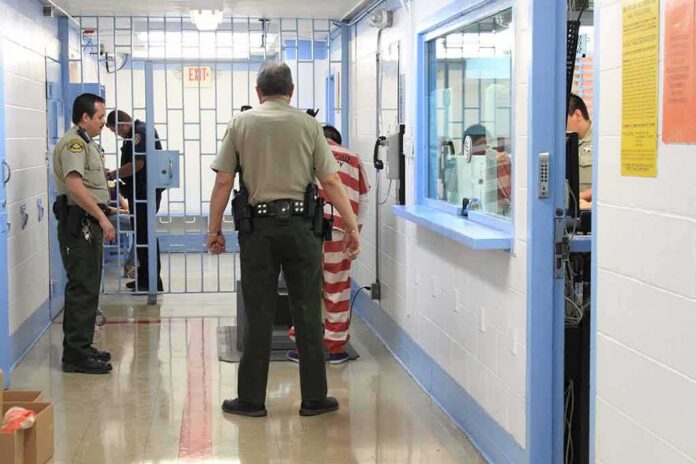
New federal and local records show people released under California’s sanctuary limits were later rearrested, sharpening a national fight over public safety and trust.
Story Snapshot
- Immigration and Customs Enforcement reported hundreds of rearrests after detainer declines in Orange County.
- Peer-reviewed and university research found no across-the-board crime increase from sanctuary policies.
- Courts upheld California’s power to limit local help with federal immigration enforcement.
- The split reflects a deeper struggle over safety, due process, and who controls local policing.
What the new numbers show in California
Immigration and Customs Enforcement (ICE) cited Orange County Sheriff’s Department data showing that in 2019, 1,015 people with ICE detainers were released without notification to ICE, and 238 were later rearrested on new charges. In 2018, 1,106 were released and 173 were later rearrested. ICE said these counts reflect rearrests at the county jail and exclude other jurisdictions, underscoring limits on the dataset and the stakes of sanctuary limits under California’s Senate Bill 54 (SB 54).
ICE also publishes declined detainer reports to highlight cases where local jails do not honor federal detainer requests. The agency frames these cases as missed handoffs that can force at-large arrests in neighborhoods, which can be riskier for officers and bystanders. The reports are designed to increase transparency in the detainer process, though they capture only a subset of events and depend on local reporting practices and federal tracking.
What rigorous studies and reviews say about crime
University and peer-reviewed research has not found a general rise in crime linked to sanctuary policies. A widely cited study reported that crime changes after sanctuary adoption across 55 cities were statistically insignificant, and several comparisons showed lower crime in sanctuary jurisdictions. The authors argue that local limits can bolster trust and reporting without inviting more crime, a claim echoed in broader academic reviews of the literature.
A University of Texas analysis reported that after 2014, both property and violent crime fell more in sanctuary counties than in nonsanctuary counties. The study relied on a large county dataset and pointed to improved outcomes where local agencies narrowed their role in civil immigration enforcement. While methods differ across studies, the direction of the evidence challenges blanket claims that sanctuary policies raise crime overall.
How the courts drew the lines on cooperation
The United States Court of Appeals for the Ninth Circuit upheld California’s SB 54 against a federal challenge, ruling in 2019 that the state could limit the use of its resources in immigration enforcement. The Supreme Court later declined to take up the case, leaving the Ninth Circuit decision in place. The rulings set a baseline: states may decide how local police allocate time and information, even if federal agencies prefer broader help.
Legal briefs and summaries from that litigation describe a core federalism fight. The federal government controls immigration law, but it cannot compel states to carry out federal tasks. Many courts have also questioned holding people solely on detainers without a judicial warrant. That legal reality explains why many sheriffs follow criminal release dates, not civil detainer requests, unless state law or a court order says otherwise.
Why both sides see risk—and what it means for safety
Critics warn that releasing people with ICE detainers, some with serious records, can lead to preventable crimes, and the Orange County rearrest figures supply concrete cases to point to. Supporters respond that the broader crime data do not show a sanctuary-driven surge and that trust helps victims and witnesses call police, which can prevent violence. Both views speak to the same public fear: the system is not matching consequences with conduct, and communities pay the price.
@elonmusk
The statewide operation underscores the Trump administration's continued push to enforce federal immigration laws despite opposition from Democrat-led sanctuary jurisdictions.👍ICE Launches Sweeping California Crackdown🙏🏽 https://t.co/MVu6s7WAEv
— Nicky (@nr2gnts) October 10, 2026
The national context heightens the stakes. Under President Trump, federal agencies continue to prioritize transfers from local jails to avoid at-large arrests, while many states and cities defend limits to keep police focused on local crime. Voters across the spectrum see a government that struggles to coordinate basic public safety tasks. Clear protocols, timely data sharing allowed by law, and faster case handling could reduce repeat harm without breaking community trust.
Sources:
deportationdata.org, ice.gov, cato.org, americanimmigrationcouncil.org, cis.org
© patriotspotlight.org 2026. All rights reserved.