
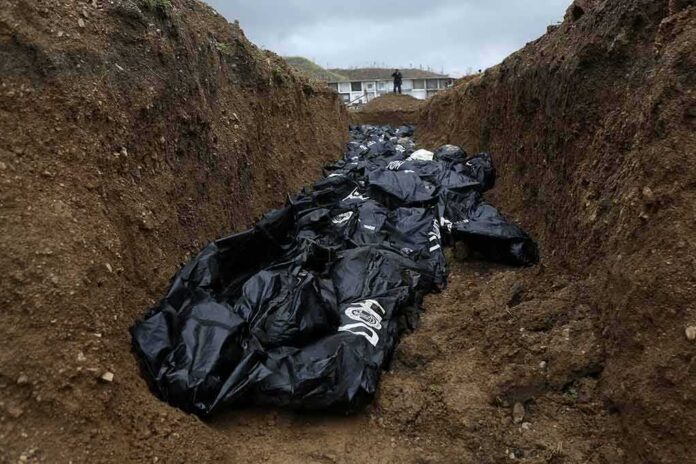
Nepal’s flood death toll climbed to 781 as officials began burying unidentified victims after collecting DNA to allow families to find and reclaim their loved ones later.
Story Snapshot
- Officials reported 781 dead and 2,502 missing after the floods.
- Authorities began burials only after taking DNA samples and logging grave locations.
- Chitwan district selected Devghat as a burial site and recorded each plot for exhumation if needed.
- Morgues were overwhelmed, pushing leaders to act for public health and dignity.
Rising Toll And Thousands Missing
Nepal’s disaster count rose sharply in recent days as search teams reached more areas. Officials reported 781 deaths and said 2,502 people remain missing, showing the scale of loss and uncertainty facing families. Police figures and earlier updates show how fast the toll has moved as recoveries continue, rising from hundreds to well over seven hundred within days. The figures may change as more remains are found and identified, but they already mark one of Nepal’s deadliest flood events this decade.
Authorities described a difficult path for investigators and volunteers. Strong currents, blocked roads, and damaged bridges slowed recovery. Rescue workers and police searched riverbanks and debris fields while documenting each find. Reporters on the ground noted bodies carried long distances by floodwaters, which adds to the challenge of matching the dead to missing-person reports. The government said the work will continue even as conditions strain staff and equipment across several districts.
Why Temporary Burials Began In Chitwan
Officials in Chitwan district started burying unidentified bodies after morgues filled and decomposition advanced. Leaders said they had to reduce health risks while still protecting the chance of later identification. Before burial, teams collected DNA samples and assigned each body a unique record. Crews placed markers above and below ground and logged precise locations to allow exhumation. India also sent forensic help to boost Nepal’s testing capacity during the surge.
The Chitwan District Security Committee chose an open public site at Devghat, in Bharatpur Metropolitan City-1, for these burials. The chief district officer worked with police and medical teams to set rules for tagging, numbering, and chain-of-custody steps. Local reporting said the plan followed Nepal’s directive on managing unidentified and unclaimed bodies. The goal is simple but hard to carry out in a crisis: protect public health today while preserving families’ rights to claim and honor their dead tomorrow.
How Documentation Protects Families’ Rights
Disaster victim identification standards call for careful records, from when a body is found to where it is laid to rest. Global guidance says to collect postmortem data, save DNA, and log burial sites so families can seek answers later. Nepal’s approach mirrors these steps under pressure: unique identifiers, DNA sampling, and mapped graves that can be reopened once matches are made. These safeguards help prevent permanent loss of identity, which is a common risk in mass disasters.
Nepal Turns to Mass Burials, as Thousands Remain Missing from Floods – The New York Times https://t.co/8WPoZNqyWM
Follow @NewsHubGlobe for 24/7 breaking news from around the world. pic.twitter.com/KZO4ygYScB
— News Hub (@NewsHubGlobe) August 31, 2026
Reports from Chitwan underline why speed and record-keeping had to move together. Local capacity was limited, bodies were found in large numbers, and heat sped up decomposition. Authorities balanced urgent health needs with dignity rituals that matter deeply across communities. Some ceremonies will have to wait until identifications are made. Officials say that is why they logged every site and kept samples, so families can receive remains for proper rites when names are confirmed.
What To Watch Next
Search and recovery will likely keep shifting the numbers as teams clear more debris. The most important milestones will be identification matches, not just raw counts. That depends on lab throughput and complete missing-person data from families. As testing advances, officials may exhume remains from Devghat to return them home. Clear public updates, including district-level tallies and identification progress, will help people track results and hold leaders to promised standards.
Sources:
youtube.com, khaleejtimes.com, thejournal.ie, english.news.cn, humanitarianlibrary.org
© patriotspotlight.org 2026. All rights reserved.