

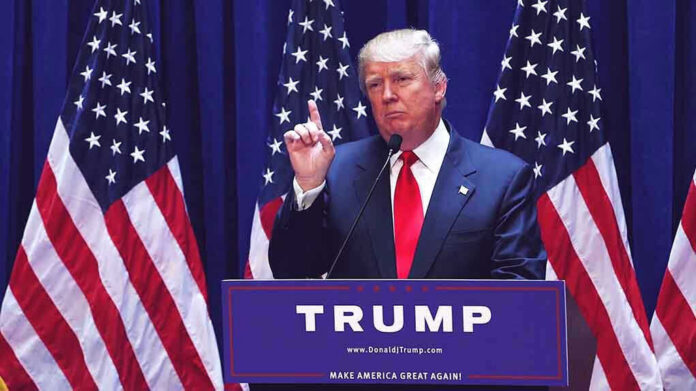
President Trump is daring the Senate to stop hiding behind procedure and finally vote on strict proof-of-citizenship rules that could reshape federal elections nationwide.
Story Snapshot
- Trump is pressuring Congress to prioritize the SAVE America Act, warning he won’t sign other bills until it advances, with a limited exception for FY2026 DHS funding.
- The House has already passed the bill; the Senate remains the bottleneck due to the 60-vote filibuster threshold and unified Democratic opposition.
- Republicans are debating a “talking filibuster” approach meant to force continuous debate and a higher-pressure path to a vote.
- House Republicans Mark Harris and Andrew Clyde are urging GOP leadership to block Senate priorities until the Senate acts.
Trump’s ultimatum puts election integrity at the center of the agenda
President Donald Trump escalated his push for the SAVE America Act by tying the rest of Washington’s agenda to it. In social media posts and public remarks, Trump demanded Senate action and urged Republicans to revive a “talking filibuster” style of debate to force progress. He also warned he would hold back his signature on other legislation until the bill moves, while carving out an exception tied to FY2026 DHS appropriations.
Trump Drops Bombshell Ultimatum on GOP Over the SAVE America Acthttps://t.co/4WiPFyF9kn
— PJ Media Updates (@PJMediaUpdates) March 17, 2026
The move is designed to compress the normal congressional calendar and make the bill a first-order priority. Supporters describe the measure as a straightforward test of whether federal elections should require strong identity and citizenship verification. Critics argue the White House is risking gridlock to win a procedural fight. The practical reality is that Trump is using his leverage as a sitting president to force a decision point the Senate has avoided.
What the SAVE America Act would change for federal voting
The SAVE America Act, as described by outlets covering the dispute, would set tighter nationwide requirements for federal elections. The core provisions include a voter ID mandate, proof of citizenship for voter registration—such as a birth certificate or passport—limits on what documents qualify, and a requirement for in-person federal voter registration. The bill also directs states to remove noncitizens from voter rolls, a provision supporters say reinforces the basic principle that only citizens vote.
Democrats argue these requirements would burden certain voters, especially those with fewer resources or less paperwork on hand. Republicans respond that the point of an election system is verification, not convenience, and that the constitutional promise of representative government depends on clean rolls and lawful participation. Based on the available reporting, the public opinion claim Trump has promoted—“88%” support—appears in political messaging but is not independently documented in the provided materials.
The Senate roadblock: filibuster math and GOP disagreements
Senate procedure is the immediate obstacle. Under modern rules, most major bills need 60 votes to overcome a filibuster, and Democrats are described as unanimously opposed. That makes the bill difficult to advance as a standard matter of scheduling. Senate Majority Leader John Thune has indicated he intends to provide “a vote of some kind,” but he has also resisted changing or bending Senate rules in ways that could later be used against Republicans if control changes hands.
That internal disagreement is central to the current fight. Some Republicans see the “talking filibuster” as a pressure tool rather than a full rewrite of Senate rules—forcing senators to physically hold the floor and defend their position publicly. Others see any procedural innovation as a slippery slope that could weaken the filibuster’s long-term value. The end result, at least for now, is that the House has acted while the Senate is still debating how—and whether—to proceed.
House Republicans push a counter-pressure campaign against the Senate
On March 16, Reps. Mark Harris of North Carolina and Andrew Clyde of Georgia amplified the White House push by urging House Republicans to block Senate priorities until the Senate acts on SAVE. Harris argued that trust in the Senate is “at rock bottom” and framed the delay as a question of seriousness about election integrity. Clyde urged Republicans to refuse to advance the Senate’s preferred items and to force the kind of “talking filibuster” showdown that would put every senator on record.
Democrats, meanwhile, are leaning into a maximalist rejection. Senate Minority Leader Chuck Schumer has described the bill as “Jim Crow 2.0” and has signaled comfort with gridlock if it blocks the legislation. With both sides describing the stakes in existential terms—election integrity versus voter suppression—the near-term outcome may depend less on persuasion and more on whether Republicans can align on a single strategy for navigating Senate rules without splintering their own conference ahead of the midterms.
Even Trump’s threat has limits that matter for governing. Reporting notes that bills can become law without a signature after a set period, meaning a refusal to sign does not always function like a veto. But it can slow momentum, complicate negotiations, and change what leadership brings to the floor. For voters who watched years of lax enforcement and bureaucratic excuses under the prior administration, the larger question is whether Washington will treat citizenship verification as a baseline requirement—or as another partisan bargaining chip.
Sources:
Trump makes SAVE America Act ultimatum
Trump makes SAVE America Act ultimatum