

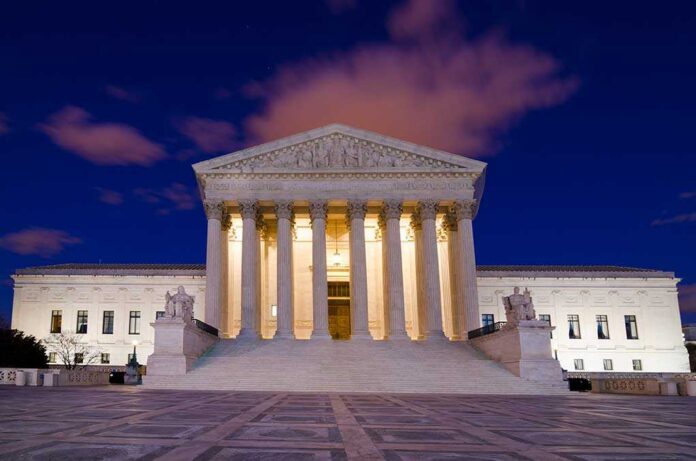
The Supreme Court has granted the government power to deport people so quickly that federal judges may never get a chance to stop it, even in cases where torture appears likely.
Quick Take
- Supreme Court emergency ruling allows rapid deportations under the Alien Enemies Act, a Civil War-era wartime law being used during peacetime.
- Justice Sotomayor’s dissent warns the decision eliminates judicial oversight by permitting removals before courts can intervene through habeas corpus challenges.
- Government previously deported a plaintiff to Guatemala despite an Immigration Judge finding he faced likely torture, then defied lower court orders blocking similar actions.
- The ruling signals a pathway for abuse where speed of removal outpaces legal protections, affecting vulnerable immigrant populations.
The Alien Enemies Act and Modern Deportations
The Alien Enemies Act, enacted in 1798, was designed as a wartime measure allowing the executive to remove nationals from enemy countries during declared conflicts. Historically invoked during World War I and II, the statute remained dormant in peacetime contexts. The 2025 Supreme Court ruling marks the first significant modern application of this law outside a formal declaration of war, raising questions about whether a peacetime administration can invoke wartime authority for mass immigration enforcement without Congressional authorization of armed conflict.
Government Defiance and Judicial Powerlessness
Court records show the government deported a plaintiff to Guatemala despite an Immigration Judge’s determination that the individual faced likely torture upon return. When a lower court issued orders blocking similar removals, the government repeatedly defied those directives. The Supreme Court then granted emergency relief, dissolving key procedural safeguards that required “reasonable time” for habeas corpus challenges. This sequence reveals a troubling pattern: executive agencies operating without restraint until the highest court intervenes, and even then, only narrowing—not eliminating—the pathway to abuse.
Sotomayor’s Warning: Speed Over Due Process
Justice Sotomayor, joined by Justices Kagan and Jackson, issued a sharp dissent characterizing the ruling as “incomprehensible as it is inexcusable” abuse of the Court’s authority. She emphasized that “in matters of life and death, it is best to proceed with caution.” The dissent highlights a critical flaw: if individuals are removed before courts can act, judicial oversight becomes meaningless. The majority acknowledged that “rushing people onto planes with no notice” violates due process, yet the ruling permits rapid removal if the government acts before filing habeas petitions, creating a loophole that rewards speed over justice.
The Practical Implications for Vulnerable Populations
Legal experts note the ruling signals a dangerous precedent. By allowing swift deportations to evade judicial review, the decision amplifies risks for individuals facing persecution, torture, or death upon return to their home countries. Immigration judges’ findings of danger lose practical weight when removal can outpace legal challenge. The ruling particularly affects asylum seekers and vulnerable migrants who depend on courts to enforce protections against refoulement—the international prohibition on returning people to places where they face torture or persecution.
A Shared Concern Across the Political Spectrum
While immigration enforcement divides Americans along partisan lines, this ruling reflects a broader concern both conservatives and liberals increasingly share: the federal government operates without meaningful checks. Conservatives worry about unchecked executive power in other contexts; liberals see it here in immigration. Both groups recognize that when speed and executive discretion trump judicial oversight, the rule of law erodes. The use of a Civil War-era wartime statute to bypass modern legal protections exemplifies the kind of governmental overreach that fuels distrust across the political spectrum.
What Comes Next
The Alien Enemies Act’s peacetime application remains unresolved legally and is expected to percolate through future Supreme Court review. For now, the ruling stands, enabling the government to proceed with rapid deportations while legal challenges languish. Sotomayor’s dissent ensures the alarm is documented, but her minority status means the majority’s approach prevails. The practical consequence: individuals facing torture or persecution may be removed before courts can meaningfully intervene, a scenario that tests whether judicial power exists at all when executive speed overwhelms procedural time.
Sources:
Transcript: Sotomayor’s Harsh New Dissent Contains One Terrifying …
[PDF] SUPREME COURT OF THE UNITED STATES
[Solved] Select the correct answer Read the excerpt from paragraph …
KEMIYA MURPHY – Americas Changing Views on Immigration …