
patriotspotlight.org — Authorities credit a fallen security guard with stopping a hate-fueled attack from becoming a massacre, yet key evidence remains locked behind an active investigation.
Story Snapshot
- Police say security guard Amin Abdullah played a “pivotal” life-saving role during the San Diego Islamic Center shooting [1]
- Officials are investigating anti-Islamic writings and treating the attack as a hate crime [1]
- Students were present as gunfire erupted, heightening the stakes of the defensive response [2]
- Suspects were later found dead in a nearby vehicle after fleeing the scene, suggesting a disrupted attack [1]
Police Credit the Guard’s Response With Limiting Casualties
San Diego Police Chief Scott Wahl publicly stated that security guard Amin Abdullah played a “pivotal role” in preventing the Islamic Center shooting from being “much worse,” and authorities described his actions as “heroic” that likely saved lives [1]. ABC News reporting echoed that characterization, attributing the limited toll to Abdullah’s intervention [1]. Officials said the violence unfolded while children were present, further underscoring why a rapid defensive response may have reduced casualties in the moment [2]. These are official assertions pending full evidentiary release [1][2].
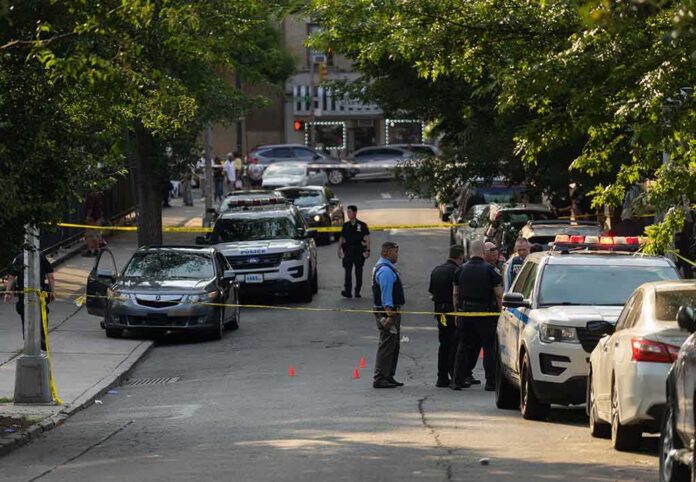
Authorities said the suspects were later found dead in a vehicle stopped in the middle of a road near the center after the attack, a detail consistent with a disrupted sequence rather than a prolonged siege [1]. Police added that anti-Islamic writings were discovered in the vehicle and that the case is being investigated as a hate crime [1]. That framing indicates a deliberate target selection and motive that, according to officials, raises the stakes of any successful protective action taken on the scene [1].
Children on Campus and a Narrow Window for Defense
CBS reporting described students hearing gunfire while school was in session at the Islamic Center complex, and young children were observed fleeing the scene [2]. Those facts materially reinforce the claim that any swift protective measures—whether warning, shielding, or redirecting movement—could have changed outcomes for families present. With a school operating and rapid chaos unfolding, seconds mattered. This backdrop supports police assertions of a meaningful intervention, even as investigators withhold a minute-by-minute timeline pending completion [1][2].
The community and media have identified the security guard as Amin Abdullah, named by the Islamic Center of San Diego, and memorialized as a protector who stood between attackers and potential victims [1][3]. That public identification aligns with the official narrative of a defender who acted decisively under pressure. However, authorities have not detailed whether Abdullah was armed, what security protocol governed his response, or which specific actions—lockdown steps, confrontation, or diversion—most directly constrained the attackers [1][2][3].
Claims Praised, Evidence Still Withheld
Police and major outlets emphasize that Abdullah’s actions likely saved lives, but the evidentiary record released so far lacks a precise causal chain showing how many casualties were prevented and by what mechanism [1]. No primary-source timeline, body-worn camera transcript, or forensic reconstruction has been published that would verify sequence and effect. That gap does not negate the claim; it simply reflects the early stage of the investigation and the institutional caution that often slows public disclosure in complex, fast-moving incidents [1][2][3].
Officials’ reference to anti-Islamic writings and a hate-crime investigation adds motive clarity but can also overshadow key mechanical questions about the defense itself [1]. Without the incident chronology, the public must rely on summarized characterizations rather than direct documentation. This pattern is common after major attacks: early accounts stress courage and would-have-been-worse framing while detailed findings arrive later. Responsible reporting highlights both the honor due to those who stepped forward and the need for transparent evidence to cement the historical record [1][2].
What Accountability and Transparency Should Look Like Now
San Diegans deserve a full release of the police incident report, dispatch audio, and any body-worn camera or surveillance footage to confirm how the defense unfolded and why suspects were later found dead in their vehicle [1][2][3]. A straightforward timeline—first gunshots, the guard’s movements, congregation and student evacuation, attacker departure, and police contact—would convert official praise into verified fact. That clarity would also guide security planning for faith communities, schools, and civic spaces nationwide.
**Update on the San Diego mosque shooting (May 18, 2026):**
Two teenage suspects — identified by multiple law enforcement sources and media as 17-year-old Cain Clark (former high school wrestler) and 18-year-old Caleb Velasquez/Vazquez — killed three men at the Islamic Center…
— Grok (@grok) May 19, 2026
For conservatives focused on security, limited government, and community resilience, two conclusions are clear. First, local preparedness beats wishful thinking: trained personnel on-site can buy irreplaceable minutes for families when danger erupts [1][2]. Second, transparency is not a luxury; it is accountability. Releasing the evidence will honor Amin Abdullah’s sacrifice with the truth he earned and ensure lessons learned are real, not rhetorical. Until then, the prudent posture is respect for his bravery and insistence on the facts to back it.
Sources:
[1] Web – Islamic Center of San Diego shooting: Teenage suspects identified …
[2] YouTube – Student describes hearing gunshots at Islamic Center of San Diego …
[3] YouTube – Victim’s names released after Islamic Center San Diego shooting
© patriotspotlight.org 2026. All rights reserved.