
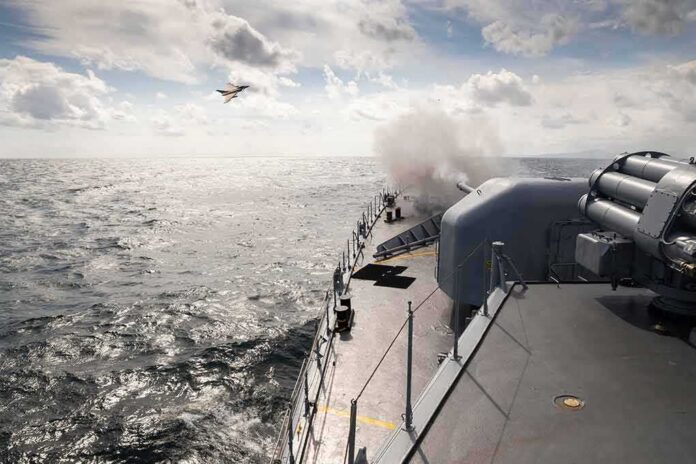
U.S. Navy Super Hornet precisely disables Iranian tanker defying Trump’s blockade, enforcing American strength against Tehran aggression amid fragile ceasefire talks.[3][4]
Story Highlights
- U.S. forces issued multiple warnings to Iranian-flagged M/T Hasna before disabling its rudder with 20mm cannon fire from F/A-18 Super Hornet off USS Abraham Lincoln.[3][4]
- Incident marks second use of force since Trump administration’s April 12 naval blockade of Iranian ports, aimed at pressuring regime for peace deal.[3][5]
- Tanker was unladen, transiting Gulf of Oman toward Iranian port in violation of blockade, confirming U.S. claims of deliberate breach.[2][3][4]
- Action upholds U.S. resolve during four-week ceasefire, countering Iranian threats to global shipping and energy security.[1][3]
- No casualties reported; blockade remains fully enforced, signaling zero tolerance for regime’s maritime provocations.
Precise Navy Action Enforces Blockade
U.S. Central Command forces observed the M/T Hasna, an Iranian-flagged unladen oil tanker, transiting international waters in the Gulf of Oman toward an Iranian port on May 6, 2026. The vessel ignored repeated warnings from American forces stating it violated the U.S. naval blockade instituted April 12.[3][4] At approximately 9 a.m. Eastern Time, after non-compliance, a U.S. Navy F/A-18 Super Hornet launched from USS Abraham Lincoln (CVN 72) fired several 20mm cannon rounds at the tanker’s rudder.[2][3][4]
The precision strike disabled the rudder without sinking the ship or causing casualties, ensuring the M/T Hasna ceased transiting to Iran. CENTCOM confirmed the tanker was no longer operational for its intended route. This method targeted vulnerability on the unladen vessel’s exposed rudder, showcasing superior U.S. naval technology and restraint.[3][7][8]
Trump Administration’s Blockade Strategy Succeeds
President Trump’s Truth Social announcement on April 12 initiated the blockade of Iranian ports, including the Strait of Hormuz, to counter regime disruptions threatening global oil flows. This incident represents the second kinetic enforcement action against Iranian commercial vessels since implementation.[3][5] Earlier, USS Spruance used its 5-inch gun to stop another sanctioned ship bound for Bandar Abbas.[8]
The blockade pressures Iran amid ongoing ceasefire talks, with Trump issuing ultimatums for a deal to end hostilities. Defense Secretary Pete Hegseth affirmed the ceasefire holds despite escalated enforcement. U.S. forces also destroyed six Iranian small craft threatening civilian shipping earlier in the week, protecting allies and energy markets.[7][8]
“U.S. forces disabled the tanker’s rudder by firing several rounds from the 20mm cannon gun of a U.S. Navy F/A-18 Super Hornet launched from USS Abraham Lincoln (CVN 72). Hasna is no longer transiting to Iran.” https://t.co/KP0XSS57xR
— Lucas Tomlinson (@LucasFoxNews) May 6, 2026
Strategic Victory Amid Ceasefire and Threats
This operation occurred during a four-week ceasefire, yet U.S. actions reaffirm commitment to national security and conservative principles of strength over appeasement. Iran’s prior IRGC attacks on merchant ships and mines in the strait justified the blockade, preventing economic chaos from regime overreach. Domestic gas prices above $4/gallon highlight stakes, but enforcement secures long-term energy independence.
Counter-claims of U.S. aggression lack evidence rebutting warnings or the tanker’s course; no Iranian crew statements or logs contradict CENTCOM reports. International law supports such interdictions in historical blockades like the Cuban Missile Crisis, where warnings preceded action. Releasing footage could further validate U.S. position, countering adversarial narratives.[3][6]
Sources:
[1] The Latest: US military fires on Iranian-flagged oil tanker as Trump presses for deal to end war
[2] Trump puts Iran deal on the clock with one-week ultimatum, Fox host says
[3] US forces fire at, disable Iran-flagged tanker trying to evade blockade
[4] Navy Super Hornet fires on, disables Iranian tanker attempting to run blockade
[5] US military fires on Iranian-flagged oil tanker in Gulf of Oman
[6]
[7] US fires on Iranian oil tanker as Trump pressures Tehran for deal to …
[8]