
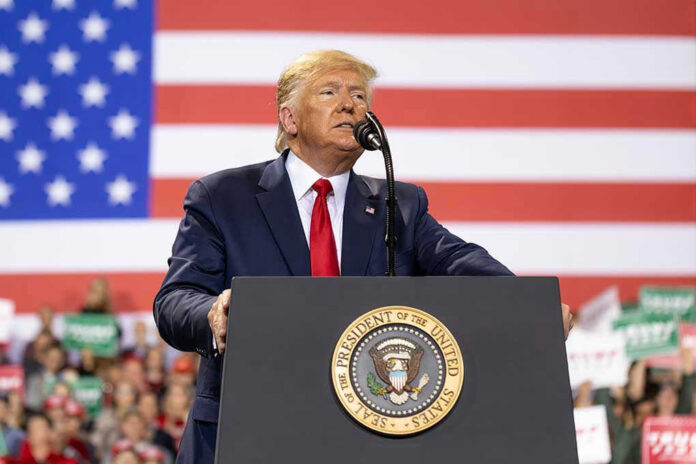
Eight days before a potential government shutdown, President Trump’s stunning cancellation of a meeting with top Democrats reveals a high-stakes standoff where brinkmanship, political calculation, and American taxpayer interests collide.
Story Snapshot
- President Trump abruptly canceled a meeting with Democratic leaders, escalating government shutdown fears.
- Trump accused Democrats of making “unserious and ridiculous” demands, halting negotiations.
- The standoff highlights deep divisions over government funding, with both sides blaming the other for gridlock.
- Americans face uncertainty as political theater threatens essential federal services and paychecks.
Trump Walks Away: The Art of the Political Standoff
President Trump’s decision to cancel a critical meeting with top Democrats is the latest salvo in a political saga that has become as predictable as it is consequential. With just over a week before the government runs out of money, Trump’s public rebuke of Democratic leaders—dismissing their proposals as “unserious and ridiculous”—puts the fate of government funding on a razor’s edge. For Republicans, the move signals a refusal to compromise on terms they view as excessive; for Democrats, it’s another example of Trump’s confrontational, zero-sum negotiating style. The country, as always, is caught in the crossfire, with millions bracing for the fallout if Washington cannot reach a deal.
Both parties have spent months drawing red lines, but Trump’s abrupt withdrawal from the negotiating table is more than a tactical maneuver—it’s a calculated gamble. The president’s supporters say he’s standing up to political gamesmanship, refusing to give ground to what he characterizes as unreasonable demands. Critics argue that the move is a grandstanding tactic, prioritizing headlines over problem-solving. Either way, the stakes are real: a government shutdown looms, threatening everything from federal paychecks to vital public services. Americans watching this political theater may wonder whether anyone in Washington remembers who ultimately foots the bill for these standoffs.
Demands, Deadlock, and the Specter of Shutdown
The core dispute centers on government funding—a perennial battleground where policy priorities become bargaining chips. Democrats have pressed for expanded social spending and protections for various programs, while Republicans, led by Trump, have balked at what they see as excessive or ideologically driven provisions. The president’s use of terms like “unserious and ridiculous” is not just rhetoric; it reflects a deep mistrust of Democratic intentions and a belief that compromise would betray his base. From the Democratic perspective, the standoff is evidence of an administration unwilling to engage in good-faith negotiation. Each side claims to defend American interests, but neither appears willing to blink first.
Trump’s public exit from the talks has shifted the onus to Democratic leaders, who now face pressure to modify their demands or risk being cast as obstructionists. The political calculus is complex: both sides are keenly aware of the optics, with each hoping to pin the blame for a potential shutdown on the other. The outcome will likely shape not just the immediate fate of government operations but also the broader narrative heading into future elections. As tempers flare and deadlines loom, the American public is left to ponder: at what point does political brinkmanship become national self-sabotage?
The Real Cost: Americans Stuck in the Middle
While politicians trade barbs and posture for the cameras, ordinary Americans face the real consequences of Washington’s dysfunction. A government shutdown isn’t an abstract concept—it means delayed pay for federal workers, shuttered parks, stalled services, and uncertainty for families and businesses. For many, the spectacle of political leaders walking away from the table only deepens cynicism about the nation’s ability to govern itself. The question of who is “unserious” or “ridiculous” may be less important than whether anyone is willing to put the country ahead of partisan advantage.
The coming days will test the resolve of both parties. Will pressure from constituents force a compromise, or will the desire to claim victory outweigh the need to keep the government functioning? For now, the American people watch and wait, hoping that someone in the room—or perhaps outside of it—remembers what’s at stake. As the deadline approaches, the drama in Washington may be entertaining, but for millions, it’s anything but a game.
Sources:
A Step-by-Step Guide to Writing Compelling Introductions – Wordtune
How to Write an Introduction, With Examples – Grammarly
9 Feature Article Intros to Hook Your Readers