
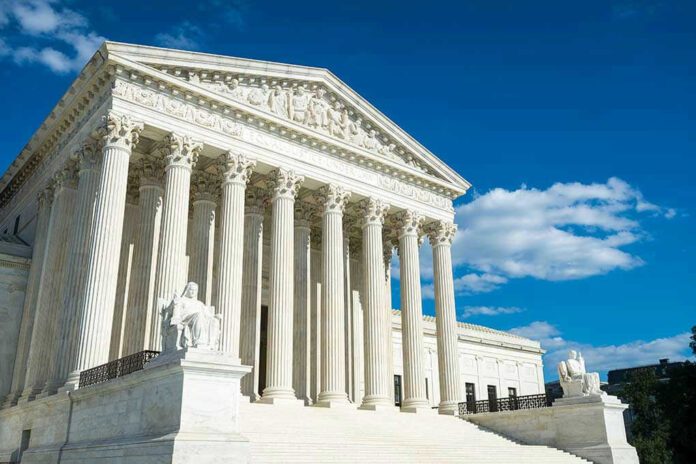
The Supreme Court just handed President Trump the green light to gut the federal workforce, ending decades of bureaucratic insulation and putting government bloat—and its union defenders—on notice that no job is sacred when taxpayers are footing the bill.
At a Glance
- The Supreme Court lifted an injunction, allowing mass federal layoffs under Trump’s executive order to proceed while litigation continues.
- Trump’s move targets “waste, bloat, and insularity” in Washington, aiming to restore executive accountability and rein in runaway government.
- Labor unions and progressive activists decry the ruling, warning of “irreparable harm” and the politicization of the civil service.
- The decision signals a seismic shift in presidential authority, raising the stakes for future administrations and the very structure of federal employment.
Supreme Court Ruling Strips Away Bureaucratic Armor
In a 2025 decision that has set the halls of Washington buzzing—and sent union bosses scrambling—the Supreme Court allowed the Trump administration to push forward with sweeping layoffs throughout federal agencies. This ruling lifts a previous injunction that had frozen the administration’s plans to slash the federal payroll, a move President Trump framed as a long-overdue effort to restore accountability, eliminate entrenched waste, and return power to elected officials rather than unaccountable career bureaucrats. The executive order, issued in February 2025, directed agencies to prepare for “large-scale reductions in force,” targeting what Trump described as a government that had ballooned beyond all common sense. The Office of Personnel Management wasted no time, telling agencies to dust off their pink slips and draft blueprints for downsizing—an act that sent union leaders and progressive advocacy groups stampeding to the courthouse.
The legal wrangling began in earnest after a coalition of labor unions, non-profits, and local governments sued to block the firings. They argued that the administration was running roughshod over federal law by bypassing Congress, using executive muscle to gut entire departments. Judge Susan Illston obliged, slapping a temporary injunction on the layoffs while the case wound its way through the courts. But the Supreme Court’s unsigned July 8 order swept that obstacle aside, finding that the administration is likely to win on the core legal question and allowing mass layoffs to resume immediately. Only Justice Ketanji Brown Jackson dissented, warning of “irreparable harm” and the unprecedented dismantling of the federal government without a single vote from Congress.
Who’s Calling the Shots? Power Dynamics Upended
The decision marks a dramatic shift in the balance of power between the executive branch and the vast federal workforce. For years, the so-called “deep state” and its union protectors have enjoyed near-untouchable status, with multiple layers of job security and endless appeals standing between them and accountability. Trump’s order, and now the Supreme Court’s blessing, threatens to rip away that safety net. As agencies from the State Department to Veterans Affairs brace for potentially tens of thousands of layoffs, the message is clear: executive authority is back, and bureaucratic immunity is out the window—at least for now. Union officials are fuming, warning that this move will devastate public services and erode the merit-based civil service. But supporters point out that the explosion in government payroll—fueled by unchecked spending and political patronage—has become unsustainable for taxpayers and corrosive to the very idea of responsive, limited government.
Labor unions and progressive activists, who have long treated the federal workforce as their own private fiefdom, are now in panic mode, filing new lawsuits and ramping up public campaigns to pressure Congress and the courts. But the Supreme Court’s decision signals a willingness to defer to the president on matters of executive reorganization, especially when the alternative is endless litigation and gridlock. For good or ill, this is a victory for common sense over red tape, and a warning shot across the bow of any future administration tempted to treat the federal government as a jobs program rather than a tool of public service.
Impacts: From Bureaucrat Row to Main Street
The immediate fallout will be felt most acutely by federal employees—tens of thousands of whom could be shown the door in coming months. Agencies are expected to move quickly to resume layoffs that had been on hold, with the Departments of State, Treasury, Transportation, and the Social Security Administration all on the chopping block. This will not only trim the bureaucratic fat but may also disrupt services in the short term. Unions are bracing for a bitter fight to protect their members, but the administration has made it clear: the days of untouchable government jobs are over. For communities dependent on federal largesse, the ripple effects could be significant, with local economies and public programs facing an uncertain future.
Yet for taxpayers and small business owners who have watched their hard-earned dollars disappear into a black hole of federal waste, this ruling is a breath of fresh air. It restores the principle that government should serve the people, not the other way around. The legal battle isn’t over—lower courts will continue to hash out the finer points of executive authority—but the high court’s message is unmistakable: presidents have the right, and perhaps the duty, to rein in out-of-control bureaucracies. Whether this leads to a leaner, more efficient government or sparks a new era of partisan warfare over the civil service remains to be seen.
Expert Perspectives and the Road Ahead
Legal scholars see this as part of a broader judicial trend: the Supreme Court is increasingly reluctant to let unelected judges tie the hands of the executive branch on administrative matters. Labor experts, meanwhile, warn of the dangers of politicizing the civil service and the risk of gutting agencies that provide critical services. Justice Jackson’s dissent, which decried the lack of congressional oversight, is likely to become a rallying cry for those who fear the rise of presidential power at the expense of institutional checks and balances. But for many Americans, the real outrage is not the layoffs themselves but the decades of government expansion, inefficiency, and unaccountability that made such drastic action necessary in the first place.
The bottom line: the Supreme Court’s ruling is a wake-up call to every federal employee, union boss, and taxpayer—the days of bureaucratic inertia are numbered. Whether this marks the dawn of a new era of government accountability or simply the latest skirmish in a never-ending war over the size and scope of Washington, one thing is clear: the American people are finally getting a say in how their government is run—and who gets to keep their job.