

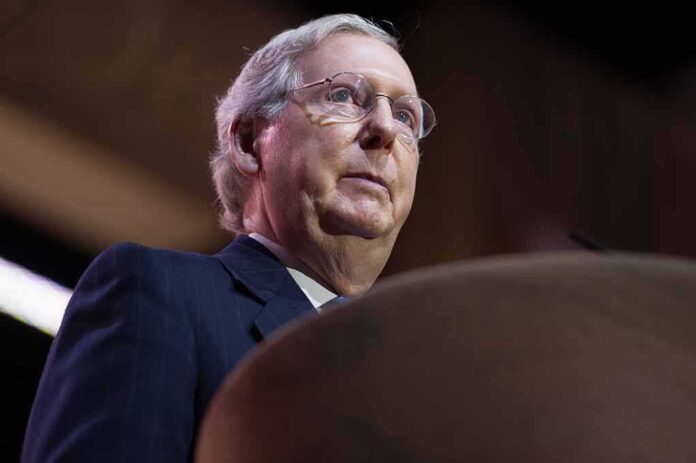
Sen. Mitch McConnell’s latest hospital stay is a reminder that Washington’s aging power structure can change the Senate’s direction overnight—whether voters get a say or not.
Quick Take
- McConnell checked himself into a local hospital Monday night after experiencing flu-like symptoms over the weekend, according to his spokesperson.
- His office described the visit as precautionary and said his prognosis is positive, with McConnell staying in contact with staff.
- McConnell voted Friday on government funding and spoke on a defense bill, but he missed votes this week while being evaluated.
- The episode revives questions about congressional fitness and continuity, especially after McConnell’s recent history of falls and public “freezing” incidents.
What McConnell’s office says happened—and what we still don’t know
Sen. Mitch McConnell, a senior Kentucky Republican and former Senate GOP leader, was hospitalized Monday night for evaluation after reporting “flu-like symptoms” over the weekend. Spokesman David Popp said McConnell went in “in an abundance of caution,” received “excellent care,” and has a positive prognosis. Popp also said the senator remains in touch with his staff and is eager to return to Senate business. The reports did not identify the specific hospital or provide a discharge timeline.
BREAKING: Sen. Mitch McConnell, 83, hospitalized with flu-like symptoms.
He should've retired long ago. 👇 pic.twitter.com/vCNnaxNMXY
— TeamCharlieKirk (@TeamCharliekirk) February 4, 2026
McConnell’s most recent public schedule, as described in reporting, suggests he was active shortly before the hospitalization. He voted on Friday in a government funding context and delivered remarks related to a defense bill, then missed votes this week as the evaluation continued. Beyond the spokesperson’s statement, there were no independent medical details offered in the available coverage, leaving the public with limited information about the severity, cause, or expected length of absence.
A long career—and a recent string of health scares—collide with Senate reality
McConnell’s hospitalization is drawing attention partly because it fits into a broader pattern of recent health incidents. He has previously been hospitalized after a 2023 fall at a Washington hotel that resulted in a concussion and broken rib, according to the same set of reports. Coverage also references two separate “freezing” episodes in 2023 that raised concerns about his health in public settings. In late 2024, he reportedly fell again at a Senate Republican lunch, suffering a minor facial cut and a sprained wrist.
The context matters because McConnell is not merely a backbench senator. He served 18 years as Senate Republican leader—the longest in history—before stepping down from leadership in 2024, when Sen. John Thune became Majority Leader. McConnell also announced in February 2025 that he would not seek reelection in 2026, signaling an end to more than four decades in the Senate. Even after leaving leadership, his influence inside the Republican conference has remained significant.
Continuity vs. accountability: what an absence can mean in a closely divided chamber
The immediate impact appears limited based on what has been reported so far, with no clear sign of a legislative logjam tied directly to McConnell’s absence. Still, a high-profile senator missing votes during an active session underscores how fragile Senate operations can be when margins are tight and key procedural votes arise quickly. For voters who want transparent, accountable government—especially after years of backroom policymaking—episodes like this highlight how much power can hinge on a single seat’s availability.
Why conservatives are watching this closely in 2026
Conservatives have spent years pushing back against government overreach, wasteful spending, and progressive cultural agendas that bypass everyday Americans. In that climate, stability and clarity in elected leadership matters—particularly when the Senate is dealing with funding fights, defense priorities, and oversight responsibilities. The available reporting does not suggest any constitutional crisis or immediate transfer of power triggered by McConnell’s hospitalization, but it does spotlight a recurring issue: Washington’s tendency to rely on aging leadership while offering voters few tools to demand change beyond elections.
Mitch McConnell, 83, Hospitalized With ‘Flu-Like Symptoms’ https://t.co/QJc28TsBOe
— Mediaite (@Mediaite) February 4, 2026
For now, the public is left with a narrow set of confirmed facts: McConnell sought evaluation after flu-like symptoms, his office says the outlook is positive, and he has remained in contact with staff. Until additional medical details or an updated timeline is released, responsible coverage should avoid speculation. At the same time, the episode will likely intensify a debate already simmering across the country—how Congress handles fitness for duty, transparency, and continuity when senior lawmakers face repeated health interruptions.
Sources:
Sen. Mitch McConnell Hospitalized After Experiencing ‘Flu-Like Symptoms’
Sen. Mitch McConnell hospitalized experiencing ‘flu-like symptoms’
Sen. Mitch McConnell hospitalized with ‘flu-like symptoms’