
Federal banking regulators just warned California that a climate rule could push national banks to leave the state entirely.
Story Snapshot
- The Office of the Comptroller of the Currency (OCC) sent a letter to California regulators on October 29 asking them to exempt national banks from two climate-disclosure laws.
- The OCC warns the rules could conflict with federal banking law and raise costs for customers nationwide.
- California’s own planning documents list banking and finance companies among the industries the laws cover.
- The clash sets up a legal fight over whether states can regulate how national banks report climate risk.
Federal Regulator Challenges State Climate Law
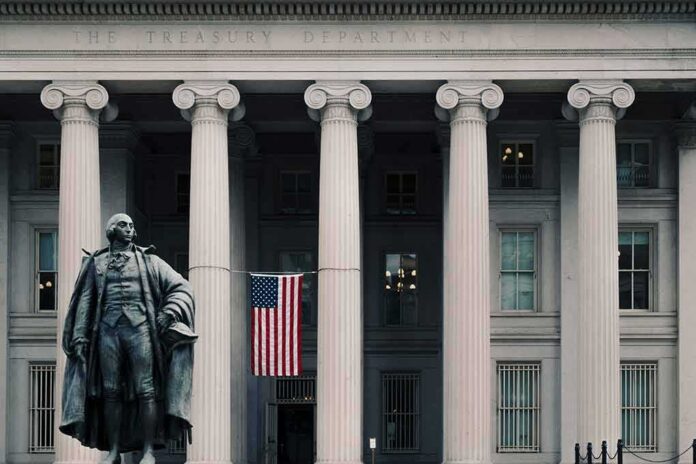
The Office of the Comptroller of the Currency, part of the U.S. Treasury Department, sent a letter to the California Air Resources Board on October 29. The letter asks the state agency to exempt national banks and federal savings associations from two climate-disclosure laws, or clearly state they do not apply. The OCC says applying these rules to federally chartered banks raises “serious policy and legal concerns”.
Comptroller Jonathan Gould leads the agency making the request. His letter argues the state laws could clash with existing federal bank safety rules. It also warns the mismatch could disrupt how banks serve customers across the country, not just in California.
What The California Laws Actually Require
The two laws at issue are Senate Bill 253 and Senate Bill 261. Senate Bill 253 requires large U.S. companies doing business in California, those earning more than one billion dollars a year, to report their greenhouse gas emissions. California’s Office of Administrative Law gave final approval to the rules on October 12, setting a November 10 deadline for the first reports.
California’s own planning documents do not carve out an exception for banks. Workshop materials from July 2026 list “companies involved in banking, insurance, asset management, investment, fintech, credit union services” among the sectors the law covers. Listening-session documents from August and September repeat that same list, naming banking and finance businesses directly.
A Preemption Fight Rooted In Old Law
The OCC’s argument rests on a legal idea that goes back two centuries. Federal courts have long held that national banks operate under federal charters that are “not normally limited by, but rather ordinarily pre-empting, contrary state law”. That principle traces to the 1819 Supreme Court case McCulloch v. Maryland and has guided bank regulation ever since.
The OCC itself acknowledges that California’s agency has real authority here. The letter states that California’s climate board “is responsible for administering the disclosure laws and has authority to issue implementing regulations”. That means the dispute isn’t about whether California can regulate companies. It’s about whether that power reaches banks chartered by the federal government instead of the state.
Why The Stakes Go Beyond Banking Rules
This fight fits a bigger pattern many Americans already notice. Federal agencies and state governments keep issuing rules that collide, leaving businesses and consumers to sort out which one wins. The OCC warns that without clarity, banks could face conflicting legal duties, duties that cost money and could ultimately get passed on to customers through fees or reduced services.
Supporters of California’s approach say big companies, including banks, should disclose their climate risks just like any other large employer doing business in the state. Critics counter that piling state-specific paperwork onto federally regulated banks does little for the environment while adding cost and confusion. Neither side disputes what the laws say; they disagree over who has to follow them.
What Happens Next
California has not yet issued a public response specifically addressing the OCC’s request for a bank exemption. The American Banker news outlet reports the OCC is not ruling out moving toward a formal preemption decision if the state does not act. With the November 10 reporting deadline approaching, banks operating in California face real uncertainty about which rules apply to them right now.
The @USOCC just told California that two of its climate disclosure laws should not reach national banks.
In a letter to @AirResources, Comptroller Jonathan Gould (@USComptroller) argued the laws would be "inconsistent with OCC regulation and safety and soundness" and would… https://t.co/f09GsqGAsT
— Chris Nobili (@chrisnobili) October 30, 2026
The outcome could shape how far states can push climate-reporting rules onto federally regulated industries nationwide, not just in California. For now, banks, regulators, and California officials are watching to see whether this becomes a drawn-out legal battle or gets resolved through a simple clarification.
Sources:
nypost.com, occ.treas.gov, bankingjournal.aba.com, occ.gov, thebanker.com, podcasts.apple.com, mlex.com, hoodline.com
© patriotspotlight.org 2026. All rights reserved.