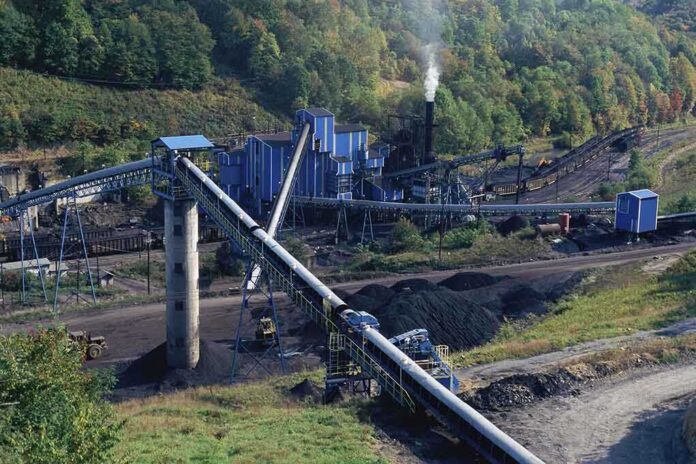
A revived push for “beautiful, clean coal” is about to test whether Washington can still protect American energy security from green ideology and grid fragility.
Story Snapshot
- President Trump plans nearly $700 million in new federal support for coal plants and a West Coast export terminal using Defense Production Act authority.[1][2]
- The package includes funds to upgrade 13 existing coal plants, build 2 new ones, and restart at least one previously idled facility.[1][3]
- Supporters say the plan defends grid reliability, national security, and high-paying jobs after years of “war on coal.”[2]
- Critics warn taxpayers could be on the hook for subsidies to aging plants even as coal’s overall market share continues to decline.[2]
Trump’s $700 Million Bet on Coal and National Security
President Donald Trump is preparing to direct roughly $700 million in federal support to coal-fired power and coal exports, invoking the Cold War-era Defense Production Act to classify reliable baseload power as a national security priority.[1][2] According to a White House official, about $425 million in Defense Production Act funds will flow to 13 existing coal plants across states such as West Virginia, Kentucky, Indiana, North Dakota, and others, with money available for critical upgrades that keep these units online.[1][3]
The initiative also sets aside another $185 million in Department of Energy grant funding to help build two new coal plants in Alaska and West Virginia, plus restart the AES Warrior Run generating station in Maryland, with private developers providing matching funds that could bring total project spending near $386 million.[1] The White House frames this as part of a broader strategy, launched by executive orders in 2025 and 2026, to “reinvigorate America’s beautiful, clean coal industry” and strengthen the defense industrial base.
How the Money Flows: Plants, Terminal, and Power Contracts
Under the plan, Defense Production Act dollars will target specific plants and regions, including facilities owned by major utilities such as Duke Energy, Oklahoma Gas & Electric, Hallador Energy, and subsidiaries of American Electric Power, helping pay for modernization, life-extension work, and reliability-focused retrofits.[1] The Department of Energy has separately redirected more than $500 million in previously unobligated carbon-capture and infrastructure law funds to support restarting, retrofitting, or rebuilding coal plants, arguing the move is legally sound and within existing authority.[2]
Beyond domestic power generation, the administration intends to use about $75 million in Defense Production Act support to advance the long-stalled West Gateway export terminal project in Oakland, California, which could ship up to 12 million tons of coal from states such as Wyoming and Montana to overseas buyers.[1] The White House has also directed the Department of War and Defense Secretary Pete Hegseth to pursue long-term power purchase agreements with coal plants to guarantee uninterrupted, on-demand electricity for military bases and critical defense facilities, explicitly tying coal capacity to national defense readiness.[1]
Supporters See Jobs and Reliability; Critics See Short-Term Boost
Coal advocates inside and outside the administration argue that years of regulations, subsidies for intermittent renewables, and market pressures have pushed dependable plants toward premature closure, undermining grid stability and threatening communities built on mining and power generation. White House fact sheets say the broader coal strategy aims to increase energy supply, lower electricity costs, stabilize the grid, and create or preserve high-paying jobs, citing more than 17 gigawatts of coal capacity reversing retirement plans since 2025.
President Donald Trump will announce a plan today to send $425 million in government funding to 13 existing coal power plants in the US, as well as $185 million to build two more, @jendlouhyhc reports.
— Josh Wingrove (@josh_wingrove) June 4, 2026
Environmental groups and some energy analysts counter that the new support is largely a reshuffling of existing federal funds and emergency authorities rather than a durable, long-term industrial strategy, warning it may yield only a short-lived reprieve for a sector whose share of United States electricity has already fallen sharply.[2] An independent analysis cited by critics estimates earlier Trump-era orders to keep uneconomic coal plants running could cost consumers several billion dollars, reinforcing concerns that taxpayers and ratepayers may shoulder higher bills to protect aging facilities instead of investing in cheaper alternatives.
Trump expected to announce $425M in government funding for 13 existing US coal plants plus $185M to build two additional plants.
— The Dive Feed (@TheDeepDiveFeed) June 4, 2026
Sources:
[1] Web – Trump plans $700 million investment in new coal plants and terminal
[2] YouTube – Trump directs Pentagon to buy electricity from coal plants
[3] Web – Trump admin redirects carbon capture funds to prop up old coal plants
© patriotspotlight.org 2026. All rights reserved.