

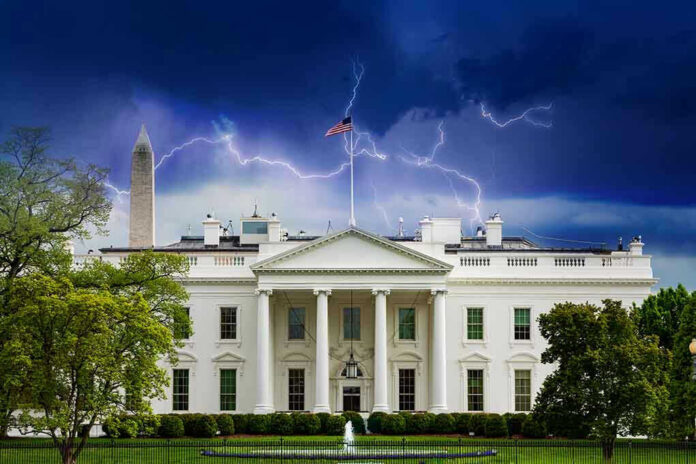
As Americans brace for war abroad, President Trump’s revelation of a “massive” military complex being built under the White House is reigniting a home-front question conservatives can’t ignore: who decides what “national security” justifies, and how much secrecy is too much?
Quick Take
- President Trump says the U.S. military is building a “massive complex” underground beneath a new White House State Ballroom.
- Trump says the above-ground ballroom is effectively a “shed” for the subterranean structure, with security features like bulletproof glass and drone-proofing.
- The project’s visible portion is described as fully funded by private donors and Trump, with no taxpayer funding claimed, while underground costs are treated as classified.
- A federal judge allowed construction to continue after the Justice Department argued national security, underscoring how courts often defer when secrecy is invoked.
Trump’s Air Force One Disclosure Raises New Security and Secrecy Questions
President Trump told reporters on March 29, 2026, that the U.S. military is building a “massive complex” beneath the new White House State Ballroom, describing the ballroom itself as essentially a “shed” on top of the underground build. Trump also highlighted hardening features, including bulletproof glass and protection against drones. The underground scope, purpose, and cost details have not been publicly described beyond being treated as “top secret.”
Trump’s comments land in a tense moment for many conservative voters: Washington is focused on high-stakes conflict abroad, while everyday Americans are watching energy prices, deficits, and institutional credibility. The statement is striking partly because it confirms direct military construction beneath the White House while the public-facing project is marketed as a donor-funded ballroom upgrade. That split between “public” and “classified” is exactly where skepticism tends to grow.
A Fast-Tracked East Wing Rebuild Replaced the Old Emergency Operations Center
The timeline described in public reporting and background materials shows the East Wing modernization moving quickly since mid-2025. After plans were announced and contractors engaged, the East Wing was demolished in October 2025, and the Presidential Emergency Operations Center was dismantled. The new construction includes a large state ballroom and additional facilities such as updated offices and a renovated movie theater, along with connections back to the Executive Residence.
Trump’s disclosure adds a new layer to that rebuild: the replacement is not just a typical below-grade renovation but a major underground complex built by the military. The public has long known the White House maintains emergency capabilities, but the project described now appears larger in scope than a simple refurbishment. Because the underground component is classified, citizens are left to infer the boundaries of the project based on hints, not transparent line items.
Private Donors, “No Taxpayer Money,” and the Oversight Problem Conservatives Recognize
Trump has emphasized that the ballroom project is funded by private donors and himself, repeatedly framing it as “not one dime” of taxpayer money. Supporters see that as a welcome break from Washington’s habit of spending first and explaining later. But the same reporting also indicates key underground elements and costs are treated as classified, creating a practical oversight gap: private funding may cover the visible structure while taxpayers may still be unable to evaluate what the classified component entails.
This matters to constitutional-minded voters because government accountability is not just about who writes the check; it is also about who gets to ask questions. If the rationale is national security, Congress and the public typically receive less information, not more. That dynamic can be necessary in narrow circumstances, but it also creates conditions where trust becomes the only guardrail. The research provided does not include public detail sufficient to judge where that line is being drawn.
Courts and Commissions Signed Off, with National Security Doing Heavy Lifting
Approvals described in the research show multiple layers of institutional clearance, including design and planning reviews and a court fight that tested the project’s authority. The Justice Department cited national security in filings, and Judge Richard J. Leon ultimately allowed construction to continue. The record presented indicates the judicial decision turned in part on deference to security arguments, a pattern Americans have seen repeatedly when classified infrastructure is involved.
For conservatives already wary of sprawling federal power, the precedent is the real story: once “national security” becomes the decisive phrase, ordinary checks often narrow. That does not automatically mean wrongdoing, and the provided sources do not prove misuse. It does mean the public standard shifts from verification to faith. In 2026—during a major overseas war—many Trump voters are demanding more clarity, not less, about what is being done in their name.
President Trump Reveals Military Building 'Massive Complex' Under Ballroom https://t.co/1XCFgQbZ74
— JaneDoe (@JaneOpines) March 30, 2026
Trump portrays the project as a security upgrade that is ahead of schedule and under budget, and he presents the donor-funded model as a win for taxpayers. Critics flagged in the background materials focus on speed, permitting, and the opacity of donor amounts. With underground details classified, Americans cannot independently verify the size, function, or total cost of the subterranean complex. What voters can verify is the governing approach: big decisions justified by threat environments, with limited public visibility.
Sources:
Trump claims donor funded White House ballroom includes hidden build below, security focus
US military building ‘big complex’ under White House ballroom: Trump