One Oval Office outburst can ignite a year’s worth of political firestorms—and Trump’s latest salvo against Rep. Jasmine Crockett and Rep. Ilhan Omar shows just how easily American civility gets torched in the heat of culture war politics.
Story Highlights
- Trump publicly insulted Reps. Jasmine Crockett and Ilhan Omar during an Oval Office event, using language widely condemned as racist and sexist.
- The remarks followed the assassination of conservative activist Charlie Kirk and sharp rhetoric from Crockett and Omar, intensifying partisan hostilities.
- Trump suggested to Somalia’s president that Ilhan Omar be “taken back,” reviving earlier controversies over his treatment of minority lawmakers.
- The incident reflects ongoing tensions around race, gender, and political legitimacy in a deeply divided America.
Trump’s Oval Office Remarks Reignite Old Feuds and Fresh Outrage
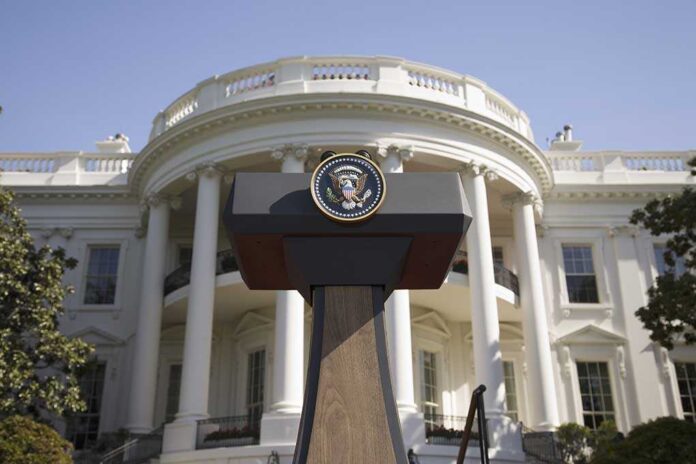
At an executive order signing, Donald Trump took direct aim at two of his most vocal progressive critics. Calling Rep. Jasmine Crockett “a very low IQ person” and joking that Somalia should “take back” Rep. Ilhan Omar, he reignited a debate that never seems to cool. Crockett had recently compared ICE to slave patrols on national television, drawing fierce criticism from conservatives. Omar, meanwhile, had made pointed remarks about the public’s reaction to Charlie Kirk’s assassination, sparking her own storm of condemnation from the right
Trump’s comments, made with senior administration officials and reporters present, were more than mere political theater. They were a calculated escalation—an effort to cast his Democratic adversaries as not just wrong, but fundamentally unfit for public life. Linking the attacks to both race and national origin, Trump’s rhetoric borrowed from his own playbook going back to his 2019 “go back” tweets, which were similarly denounced as racist by critics and defended as “plain-spoken” by supporters.
Trump blasts Rep. Jasmine Crockett as ‘low IQ,’ jokes Somalia should ‘take back’ Ilhan Omar https://t.co/FOygqMc3i7
— Fox News Politics (@foxnewspolitics) September 26, 2025
Background: Political Patterns and Personal Flashpoints
The roots of this latest conflict run deep. Trump has made a habit of targeting members of the so-called Democratic “Squad”—Omar, Alexandria Ocasio-Cortez, Ayanna Pressley, and Rashida Tlaib—especially those who are women of color. Crockett, a freshman congresswoman from Texas and a public defender, had built her reputation on outspoken civil rights advocacy. Omar, a Somali-born refugee and one of the most prominent Muslim lawmakers in the country, is no stranger to Trump’s ire. Each has faced relentless attacks, both personal and political, often framed as part of a broader conservative strategy to paint progressive Democrats as radical and out of touch.
The immediate catalyst for Trump’s remarks was the killing of Charlie Kirk, a conservative activist whose death at a Utah speaking event set off a wave of partisan recrimination. Omar’s comments about Kirk’s legacy and the response to his assassination added fuel to the fire, while Crockett’s comparison of ICE to slave patrols provided a new target. Trump’s comments drew not only from these recent controversies but from years of deeply entrenched grievances and political animosities.
Pushing the Boundaries of Political Discourse
No one in the room seemed surprised by Trump’s unfiltered rhetoric. His supporters saw it as another example of his willingness to “say what others are thinking” and reject political correctness. Conservative media and influencers quickly amplified the sound bites, framing them as evidence of Democratic extremism and Trump’s refusal to back down. But to his critics—and especially to organizations like the Congressional Black Caucus and progressive Democrats—these attacks were more than strategic jabs. They were evidence of a sustained campaign to delegitimize women of color in politics, tapping into dangerous stereotypes and encouraging hostility from Trump’s base.
Rep. Ilhan Omar quickly fired back, calling Trump a “lying buffoon” and defending her record as both a U.S. citizen and an elected official. The Congressional Black Caucus and other advocacy groups denounced the comments as racist and sexist, while Trump doubled down, insisting that Crockett and Omar represented a “radical left” that threatened American values. Each volley ratcheted up the stakes, drawing more eyes—and more outrage—to the unfolding controversy.
Ripple Effects and the Future of Political Rhetoric
The fallout has been swift and severe. Media coverage has been wall-to-wall, and politicians on both sides have used the incident to rally their supporters. For Trump, the episode reinforces his image as a combative, anti-establishment figure willing to take on “the radical left” at any cost. For Crockett and Omar, it’s another reminder of the personal and professional toll exacted by public life as women of color in a polarized America.
Analysts warn that such episodes don’t just deepen partisan divides—they erode the basic norms of civility and democratic discourse. With no formal censure on the horizon and both sides digging in, the incident is likely to shape campaign messaging, fundraising, and voter turnout in the months ahead. The long-term impact may be harder to measure, but the immediate lesson is clear: in today’s America, one Oval Office insult can echo for years.