

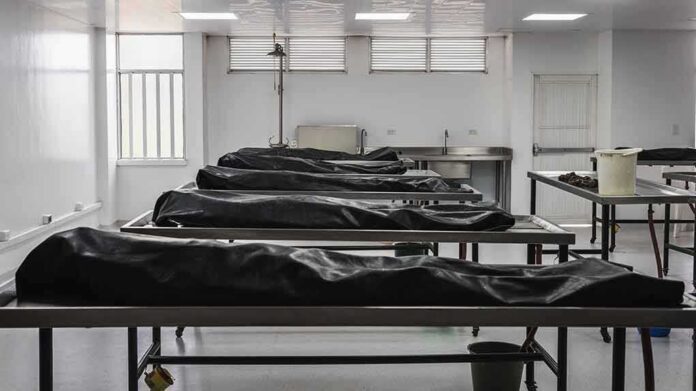
More than 50 decomposing bodies were found inside a Chicago funeral home, and state regulators say the site was unsafe, unrefrigerated, and infested with rodents and maggots.
Quick Take
- Authorities said the remains were discovered at South Chicago Chapel on Chicago’s Southeast Side.
- The Cook County medical examiner said investigators found more than 50 bodies in various stages of decomposition.
- State officials suspended a funeral director’s license after finding deplorable conditions at the site.
- Families are now waiting for identification, records review, and notice from officials.
What investigators found
Cook County medical examiner staff and forensic pathologists went to South Chicago Chapel after Illinois and city officials raised concerns about the storage of bodies. Reporting from the scene said investigators found dozens of decomposing remains, with official counts ranging from 56 to 57 bodies, depending on the source and timing of the reports. The remains were said to be in various stages of decomposition.
Officials said the bodies were kept in an unrefrigerated area under deplorable conditions, and the state cited rodent infestation, decomposition, and maggot infestation in its suspension action. Some reports also said the remains were found in multiple parts of the building, including the basement, closets, and an attached garage. The funeral home is located in the 2900 block of East 95th Street in the South Deering neighborhood.
How regulators responded
The Illinois Department of Financial and Professional Regulation suspended one funeral director’s license after finding that continued practice posed a danger to public safety, interest, and welfare. That action matters because it shows the state treated the case as an urgent health and safety failure, not just a paperwork problem. Police also joined the investigation as officials worked to recover remains, review death certificates, and sort out which bodies belonged to which families.
The case also fits a familiar pattern in death-care oversight. Serious problems often come to light only after a tip, a smell, or a complaint forces a site check. In this case, neighbors reported a foul odor for months, and authorities then moved in with inspectors and medical examiners. For families, that means the first public news is often not reassurance, but the discovery that basic care failed long before officials arrived.
Why this case is drawing wider attention
This story has gained extra attention because the same operators had been linked to another facility that was shut down over mishandled remains. That history raises a broader question about how well Illinois and local systems track repeat problems across funeral homes and crematories. For readers on both sides of the political divide, the case feeds a shared frustration: a small number of operators can fail families badly while public oversight appears to react only after the damage is visible.
🚨⚠️ Authorities discovered more than 50 bodies inside a Chicago funeral home during an investigation into allegations of improper storage.
Officials say remains were found in multiple areas of the property, some in advanced stages of decomposition and allegedly without required… pic.twitter.com/SLe18dW94L
— THE INFORMANT (@TheInformantUSA) August 8, 2026
Officials still have to identify all of the remains and notify families, which can take days or longer. No criminal charge was announced in the reporting provided, so the immediate public record centers on the discovery, the regulatory suspension, and the ongoing identification work rather than on any final court outcome. Even so, the facts already point to a breakdown in basic standards that should never have reached this stage.
Sources:
feedpress.me, abcnews.com, instagram.com, facebook.com, apnews.com
© patriotspotlight.org 2026. All rights reserved.