
A child shouting “F— ICE” at a protest drew a sharp retort from Gregory Bovino, spotlighting how far the immigration fight has pushed America’s lines on speech, policing, and civic norms.
Story Snapshot
- A viral clip shows a child leading a profane anti-ICE chant; Gregory Bovino responds forcefully.
- Public media footage documents tense standoffs between protesters and federal agents this year.
- Most demonstrations are peaceful, but a small share turns confrontational, drawing outsized attention.
- The clash reflects wider distrust of government and deep anger over immigration enforcement across the country.
What the viral exchange shows, and what it does not
Social media posts highlight a boy chanting an expletive aimed at Immigration and Customs Enforcement, while his mother records nearby. Gregory Bovino, a senior border official, is shown giving a stern verbal response. The post’s framing stresses the child’s language and the target of the chant. The clip does not show arrests, injuries, or a physical escalation in that moment. The scene feeds a larger argument over what protest speech is acceptable and how officials should react in public settings.
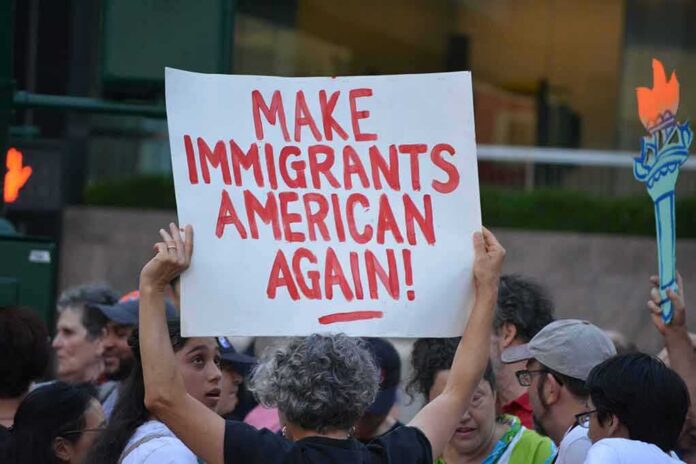
Newsrooms and advocacy outlets have shown many recent standoffs involving anti-ICE activists and federal agents. Public broadcasting footage documents chants like “ICE out!” and crowd-control orders such as “We’re going to clear you out,” reflecting a charged pattern of protest and response. These recordings place the viral clip within a season of friction where each side claims the other crossed a line. That context matters more than a single heated sound bite.
Protected speech, public safety, and the thin line between them
Courts and common policy guidance say people can criticize officials, even with harsh words, without facing force solely for speech. Training documents and legal summaries emphasize that profanity, insults, and chants are generally protected by the First Amendment unless they cross into threats or direct interference with law enforcement actions. That protection sets a clear floor for rights. It also leaves room for police to act if a protest blocks operations or risks public safety, depending on specific facts.
That legal baseline is one reason short, angry clips can mislead when watched alone. A shouted expletive often stays within protected speech. A physical blockade, an assault, or property damage does not. The divide is not always obvious in real time, especially when large crowds, loud noise, and high emotion collide. That is why neutral standards and clear orders matter on the street, and why thorough, independent reviews matter after an incident.
Why this flashpoint resonates across America
National reporting shows thousands protesting recent immigration shootings and operations, with many events remaining peaceful and some turning tense. Research tracking demonstrations finds only a small fraction escalate into violence or forceful dispersal, yet those few often dominate headlines and shape opinions. The child-and-official exchange taps into a broader frustration shared by many on the right and left: leaders seem more focused on winning the narrative than fixing the system.
'Who's Ready to Attack?': Foul-Mouthed Kid Leading Anti-ICE Chant Gets a Mouthful From Greg Bovinohttps://t.co/M2SgTiof8g pic.twitter.com/w7djev3ojO
— Twitchy Team (@TwitchyTeam) October 8, 2026
Conservatives see chaos near enforcement actions and argue that insults at officers reflect a breakdown of respect. Liberals see heavy-handed tactics and say officials criminalize dissent. Both sides point to selective clips as proof. The deeper issue is trust. People doubt that agencies and city leaders can protect rights and keep order at the same time. That doubt grows every time a viral moment replaces a full accounting of what happened before, during, and after a clash.
What to watch next: accountability and clarity
Officials can lower the temperature by releasing prompt, detailed timelines after high-profile protests, including who gave which orders and why. Agencies can reaffirm in public that verbal insults alone do not justify force, while also stating plainly what actions will trigger arrests. Protest organizers can set and enforce clear nonviolence codes. These steps are not partisan. They are basic guardrails that help preserve both free speech and public safety when the stakes—and the cameras—are on.
Sources:
twitchy.com, rawstory.com, pbs.org, bbc.com, fox9.com, propublica.org, pjmedia.com
© patriotspotlight.org 2026. All rights reserved.