
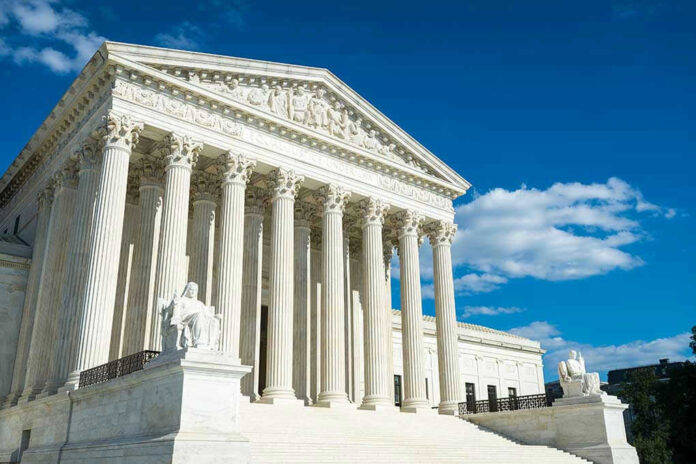
The Supreme Court’s rare decision to order reargument in a Louisiana redistricting case signals a potential constitutional earthquake that could fundamentally reshape voting rights protections and minority representation nationwide.
Story Highlights
- Supreme Court orders unprecedented reargument in Louisiana redistricting case with national implications
- Case challenges whether creating majority-Black districts to comply with Voting Rights Act violates Constitution
- Decision could drastically alter redistricting law and weaken minority voting protections across America
- Outcome directly impacts 2026 midterm elections and congressional representation in Louisiana
Supreme Court Orders Rare Reargument in Landmark Case
The U.S. Supreme Court made the extraordinary decision on June 27, 2025, to order reargument in Louisiana v. Callais, focusing specifically on whether the intentional creation of a second majority-minority district violates the Constitution. This rare procedural move underscores the case’s exceptional significance and suggests deep divisions among the justices. The reargument is scheduled for October 15, 2025, with supplemental briefs requested to address core constitutional questions about race-conscious redistricting.
Constitutional Clash Over Voting Rights Act Compliance
Louisiana’s 2024 congressional map includes two majority-Black districts, created through Senate Bill 8 after federal courts ruled the state’s previous map likely violated Section 2 of the Voting Rights Act. The original 2022 map limited Black voters to just one district despite comprising roughly one-third of Louisiana’s population. State officials now argue that drawing districts specifically to ensure Black representation constitutes unconstitutional racial gerrymandering, creating a fundamental tension between VRA compliance and Equal Protection Clause requirements.
Federal Court Battles Set Stage for Supreme Court Showdown
The legal battle began when federal courts found Louisiana’s 2022 congressional map likely violated the VRA by diluting Black voting power. In response, the legislature enacted SB 8 in 2024, creating the disputed second majority-Black district. The Supreme Court granted an emergency stay on May 15, 2024, allowing elections to proceed under the new map, then noted probable jurisdiction in November 2024. Initial oral arguments occurred on March 24, 2025, before the Court’s decision to order reargument.
Civil rights organizations, led by the NAACP Legal Defense Fund, defend the remedial map as essential for fair representation and VRA compliance. They argue the district corrects historical discrimination and ensures Black voters can elect candidates of their choice. However, opponents contend that intentionally creating majority-minority districts, even as a remedy, crosses constitutional boundaries by prioritizing race over other redistricting principles.
National Implications for Redistricting and Minority Rights
The Court’s decision will establish critical precedent for redistricting nationwide, particularly affecting states with significant minority populations. A ruling against Louisiana’s map could severely limit states’ ability to remedy VRA violations and weaken minority voting protections established over decades. This comes amid ongoing national debates over the VRA’s scope, following recent Supreme Court decisions that have narrowed its application and enforcement mechanisms.
The case’s outcome will directly impact the 2026 midterm elections and could influence control of the U.S. House of Representatives. Beyond immediate political consequences, the ruling may fundamentally alter how states balance constitutional requirements with voting rights protections, potentially affecting minority representation across multiple states and election cycles.
Sources:
Louisiana v. Callais – Legal Defense Fund