
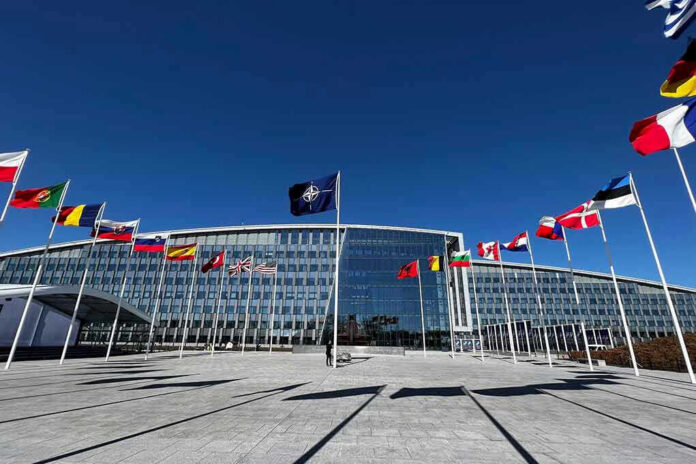
Quiet talks inside NATO about putting American nuclear forces in Poland and the Baltic states could redraw Europe’s security map and raise the stakes with Moscow overnight.
Story Snapshot
- The United States is discussing expanding NATO nuclear sharing to Poland and the Baltic states, focusing on nuclear-capable jets rather than confirmed warhead deployments.
- Poland and Baltic leaders are pushing hardest for a U.S. nuclear presence as a shield against Russia, but no final decision has been taken.
- Any move would extend a decades-old U.S. nuclear umbrella now limited to Western Europe, not create a brand‑new system.
- The talks highlight a tradeoff: stronger deterrence for Eastern allies, but higher escalation risks and new costs for American taxpayers.
What Exactly Washington Is Considering on NATO’s Eastern Front
United States officials are holding internal alliance talks about whether to extend nuclear sharing arrangements to new host countries on NATO’s eastern flank, specifically Poland and the three Baltic states.[1][4] According to reporting based on people briefed on the discussions, the focus is on deploying so‑called dual‑capable aircraft—fighter jets able to carry out normal missions or deliver U.S. nuclear bombs in wartime.[1][3][5] These talks are described as exploratory, with no agreement on actual deployment yet reached.[1][4]
Under this concept, nuclear bombs would remain owned and controlled by the United States, stored on allied territory but guarded by American personnel and released only under a joint decision in a crisis.[3] This mirrors how current nuclear sharing works in Western Europe, where B61 gravity bombs sit at air bases in countries such as Belgium, Germany, Italy, the Netherlands, and Turkey.[3][2] The possible change now under review would be geographic—moving that familiar model closer to Russia’s borders at the request of front‑line allies.[1][3][4]
Why Poland and the Baltic States Are Pushing for U.S. Nuclear Backing
Poland and the Baltic governments have been among the loudest voices calling for stronger American guarantees in the face of Russian aggression and nuclear signaling.[1][4] Poland’s leadership has openly floated the idea of hosting U.S. nuclear assets, framing it as a way to harden deterrence and ensure that any attack on Polish soil would clearly implicate Washington from day one.[1][4] The Baltic states have echoed that logic, arguing that proximity to Russia demands more than paper promises and conventional forces alone.[4][6]
This interest comes after decades in which Eastern members relied on a nuclear umbrella physically based in Western Europe, at the same small cluster of air bases used since the Cold War.[3][4] Analysts note that Eastern governments now want to move from being protected indirectly to being directly embedded in the nuclear sharing framework, believing that visible assets on their territory carry more political weight in Moscow’s calculations.[3] At the same time, experts caution that such a move would also make those countries priority targets in any nuclear confrontation.[2][6]
Long‑Running Nuclear Sharing Practice Meets New‑Era Risks
U.S. nuclear weapons have been stationed in allied European countries since the 1950s, when President Dwight Eisenhower first approved deployments to counter Soviet power.[3][5] At their height during the Cold War, thousands of warheads were spread across the continent; that number has since fallen to an estimated small stockpile held at six bases in five host nations.[2][3] Despite reductions, the basic idea—American bombs on allied soil, ready for delivery by allied pilots in allied jets—has remained a core part of NATO deterrence policy.[1][3]
Research institutions studying extended deterrence emphasize that debates like the current one recur whenever allies worry about U.S. staying power or Russia escalates its rhetoric. Supporters of expansion argue that extending nuclear sharing eastward would underscore that Washington’s umbrella is not shrinking, even as some conventional troop deployments shift.[3][6] Critics warn that moving nuclear infrastructure closer to Russia could fuel an arms race, undermine arms control efforts, and complicate alliance decision‑making in a crisis.[1][6]
What It Would Take to Turn Talks into Reality—and What It Means for America
Reports stress that the discussions inside NATO are preliminary and that no imminent deployment decision is on the table.[1][4] Turning the concept into reality would require political approval from all involved governments, major upgrades to air bases, secure storage bunkers, and certified dual‑capable aircraft fleets in host countries.[4][6] Those steps take time and money, and they would likely spark domestic debates in Europe over making specific locations nuclear targets in a standoff with Russia.[2][6]
🇺🇸🇪🇺 US is negotiating deployment of additional nuclear weapons in European NATO countries to "strengthen security guarantees"
According to some US officials, Washington is ready to deploy dual-capable nuclear aircraft in more countries beyond the current six NATO members
It… pic.twitter.com/nwHDd4ATe3
— THE TRADESMAN 📈 (@The_Tradesman1) June 3, 2026
For American conservatives, the stakes run in both directions: forward‑placed nuclear forces can reduce the odds of miscalculation by reminding Moscow that any attack on NATO’s eastern flank risks U.S. retaliation, but they also deepen America’s exposure if European leaders misjudge a crisis.[3] The record in Europe shows nuclear sharing can bolster deterrence without constant brinkmanship, yet the closer deployments move to Russia’s borders, the narrower the margin for error becomes.[3][6] Those tradeoffs will shape whether these talks stay theoretical or become concrete policy.[1][4]
Sources:
[1] Web – U.S. May Consider Placing Nukes in Poland, Baltic States
[2] Web – [PDF] United States nuclear weapons in Europe | CND
[3] Web – Fact Sheet: U.S. Nuclear Weapons in Europe
[4] Web – Nuclear Weapons in Europe: Mapping U.S. and Russian Deployments
[5] Web – US in talks to deploy additional nuclear-capable bombers in Europe …
[6] Web – U.S. Nuclear Weapons in Europe, 1954-2004 – Sage Journals
© patriotspotlight.org 2026. All rights reserved.