
patriotspotlight.org — A single viral flight with a humanoid robot just triggered a sweeping Southwest Airlines ban that says as much about fear, liability, and elite rule-making as it does about battery safety.
Story Snapshot
- Southwest now bans human-like and animal-like robots from cabins and checked bags, citing lithium-ion battery fire risks.
- The rule followed a high-profile flight of a humanoid robot “passenger” that did not involve any reported safety incident.
- The airline ties the move to lithium-ion guidelines even though similar batteries still power allowed items like laptops.
- The episode highlights how corporations can make far-reaching rules without transparent evidence, while regulators stay quiet.
What Southwest Actually Banned, and Why It Says It Did So
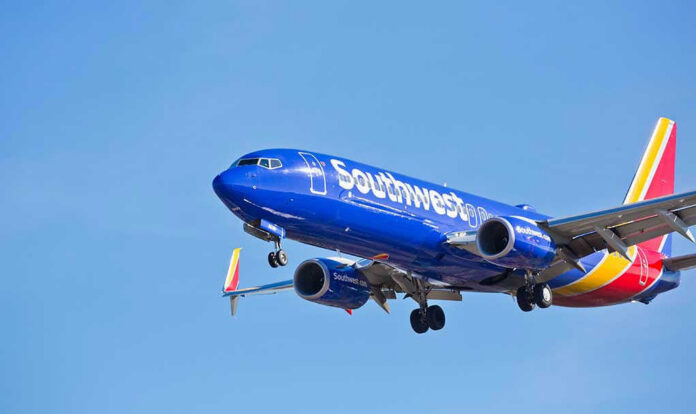
Southwest Airlines updated its baggage policy to prohibit both humanoid robots and animal-like robots from riding in the cabin or as checked baggage, formally pointing to lithium-ion battery safety rules as the reason for the change.[1] Reporting describes the update as an effort to “ensure compliance with guidelines for traveling safely with lithium-ion batteries” by explicitly including robotic devices in the restricted category.[1] The airline framed the issue around battery chemistry and size rather than the robots’ appearance, emphasizing concern about large onboard power packs.[1][3]
News coverage says Southwest’s move came days after a Dallas-area entrepreneur bought a ticket for his humanoid robot, Stewie, and flew it from Las Vegas to Dallas Love Field.[1][4] That flight drew viral attention as passengers filmed the human-sized robot seated next to them, speaking through preprogrammed phrases and drawing stares in the cabin.[4] Within roughly forty-eight hours, Southwest announced that robots like Stewie would no longer be allowed on future flights, effectively turning a one-off novelty into a system-wide safety rule.[1][4]
How Lithium-Ion Batteries Became the Stated Justification
Southwest told reporters that its robot ban aligns with existing lithium-ion battery regulations, arguing that large robots often rely on bigger batteries that could be harder to manage in a cabin emergency.[1][3] Separate reports say the owner previously had to swap Stewie’s original power pack because it exceeded legal size limits, then installed a smaller battery he described as similar to a laptop battery to pass Transportation Security Administration screening.[4] No coverage in the record describes any overheating, smoke, or fire during the actual flight.[1][4]
That gap between the stated hazard and the documented facts fuels questions shared across the political spectrum. Airlines still allow passengers to bring laptops, phones, power banks, and other lithium-powered devices, and Southwest has not publicly supplied data showing that humanoid or animal-like robots present a uniquely higher risk than those items.[1][3] The ban reportedly extends even to toy robots, widening the rule well beyond the specific large devices that originally worried safety staff.[3] Without technical thresholds or incident statistics, citizens are left to trust a vague “safety” label from a major corporation.
Regulation by Viral Moment: A Familiar Pattern
The robot decision fits a pattern Americans have seen before, where an unusual event prompts sweeping rules before anyone shares detailed evidence with the public.[1] Hoverboards were rapidly banned from many flights years ago after a series of highly publicized fires, and electronic cigarettes faced similar restrictions even when the risk profile overlapped with other allowed items. Here, the visible novelty of a talking robot in an airline seat appears to have sped up that same kind of reaction, with the rule arriving before a transparent risk analysis.[1][3]
Southwest Airlines has updated its policy after a humanoid robot named Stewie flew as a ticketed passenger from Las Vegas to Dallas. The airline now bans humanoid or animal-like robots in the cabin or as checked baggage, citing lithium-ion battery safety and operational risks.
— Bolt Flight (@BoltFlight) May 15, 2026
For people on both the right and the left who already distrust large institutions, this looks less like careful engineering judgment and more like top-down “because we said so” policymaking. There is no public Federal Aviation Administration or Transportation Security Administration document in the record that specifically demands a robot ban, and Southwest has not released internal safety memos explaining why existing lithium-ion rules were insufficient.[1][3] That silence leaves room for suspicion that corporate lawyers and public-relations teams, not engineers, are steering decisions that reshape how new technologies can be used.
What This Reveals About Power, Technology, and Everyday Freedom
Southwest’s robot policy lands at a moment when many Americans feel squeezed between powerful tech companies, regulators, and airlines that dictate rules ordinary people must follow without much say. Conservatives see yet another example of large entities hiding behind “safety” while clamping down on innovation or personal choice. Liberals see a private company exercising near-regulatory power with little accountability, despite the policy’s real-world impact on entrepreneurs, researchers, and disabled travelers who might benefit from robotic assistance.
Both sides can reasonably ask why a robot with a battery equivalent to a laptop is banned while a laptop is not, and why animals shaped like robots are treated differently from animals in carriers. Available reporting does not document any thermal runaway event involving Stewie, and does not quantify how a humanoid robot’s battery risk compares with other electronics already in the cabin.[1][3][4] Until Southwest, federal regulators, or independent engineers publish serious data instead of brief media statements, this episode stands as another reminder that powerful institutions increasingly set the boundaries of daily life first and explain themselves later, if at all.
Sources:
[1] Web – Southwest Bans Humanoid Robots After Viral Passenger Flights
[3] Web – Robots can’t fly Southwest anymore following battery fire concerns
[4] Web – Southwest Airlines bans humanoid robots from flying in new policy
© patriotspotlight.org 2026. All rights reserved.