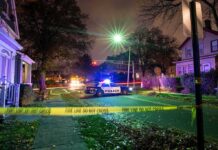


A Canadian school massacre is turning into a political Rorschach test—while families bury the dead, officials are still trying to explain how an unregistered shotgun and other guns ended up in an 18-year-old’s hands after prior police seizures.
Quick Take
- Justin VanRootselaar, the biological father of the Tumbler Ridge shooter, issued a public statement expressing condolences and emphasizing he was estranged from his child.
- Eight people were killed, including the shooter’s mother and 11-year-old half-brother, plus five students and an education assistant at Tumbler Ridge Secondary School.
- BC RCMP confirmed multiple prior police visits tied to mental health and self-harm concerns and said firearms were seized about two years earlier, then later returned to the lawful owner after petition.
- Investigators say four firearms were connected to the attack, including a shotgun described as unregistered; the primary firearm’s origin remains unknown.
- Separate reporting says misinformation about trans people spread online after the suspect’s transgender identity became a major focus of public debate.
Father’s Statement Centers on Grief and Estrangement
Justin VanRootselaar released a statement on February 13, 2026—two days after the February 11 shooting in Tumbler Ridge, British Columbia—offering condolences and asking for privacy. He said he was not part of his child’s life and that the shooter’s mother, Jennifer Jacobs, declined his involvement from the beginning. He also said the shooter never used the VanRootselaar family name and that he would not be making further statements.
Reporting also highlighted a public dispute over identity and language. News outlets described the shooter as having been assigned male at birth and transitioning to female, while noting the father referred to the shooter using male pronouns and a different name. That detail matters because it shows how quickly a criminal investigation can become a culture-war proxy fight—often before investigators finish basic questions about motive, weapon sourcing, and missed warning signs.
What Happened in Tumbler Ridge—and Who the Victims Were
Authorities say the attack left eight dead in total. Victims included Jennifer Jacobs and her 11-year-old son Emmett, along with five students at Tumbler Ridge Secondary School and an education assistant. Investigators say the shooter killed family members at home before going to the school. The suspect, identified by RCMP as 18-year-old Jesse Van Rootselaar, died from a self-inflicted gunshot wound, ending the immediate threat but not the community’s trauma.
Tumbler Ridge is described in coverage as a small place where residents recognize each other by name and see one another at local events and stores. That closeness can deepen the shock when violence erupts inside a community that does not expect it. For outside observers, it also complicates the tendency to reduce the tragedy to slogans—whether about guns, policing, ideology, or identity—because real-world relationships and prior family conflict rarely fit neat political narratives.
Prior Police Contacts Raise Questions About Intervention Limits
BC RCMP said officers made multiple visits to the home connected to concerns about mental health and self-harm. Police also said firearms were seized from the residence roughly two years before the shooting under Canada’s Criminal Code, but those firearms were later returned to the lawful owner after a petition process. RCMP leadership emphasized that seizure and return procedures do not guarantee future prevention—especially if conditions change inside a household.
From a common-sense, public-safety perspective, the case underscores a recurring tension: governments can expand rules and still fail at execution when warning signs appear repeatedly. Conservatives watching from the U.S. should recognize the lesson—Canada’s tighter gun regime did not prevent an alleged unregistered shotgun from being used, and prior police contact did not stop escalation. The most relevant policy question is less about new slogans and more about whether authorities had enforceable tools to act on credible risk.
Four Firearms, an Unregistered Shotgun, and an Unknown Origin
Investigators say four firearms were connected to the shooting—two found at the school and two at the residence. Reporting said the main firearm believed to have caused the most significant damage had never been seized previously by RCMP and that its origins remain unknown. A shotgun used in the attack was described as unregistered and also had never been seized. Those details point to an evidentiary gap that investigators still have to close: how the weapons were obtained and stored.
Until investigators can map out acquisition, storage, and access, public debate will keep drifting toward the easiest political talking points. For conservatives, the caution is straightforward: don’t let activists exploit a horrific crime to demand broad restrictions on lawful gun owners while key facts—like how an unregistered gun entered the picture—remain unsettled. The case also shows why family stability, serious mental-health intervention, and accountability around weapon access inside a home can matter as much as any headline-grabbing policy push.
Sources:
Tumbler Ridge shooting misinformation about trans people
Father of Tumbler Ridge, B.C. school shooter issues statement
‘Words feel far too small’: Tumbler Ridge shooting suspect’s father issues statement