
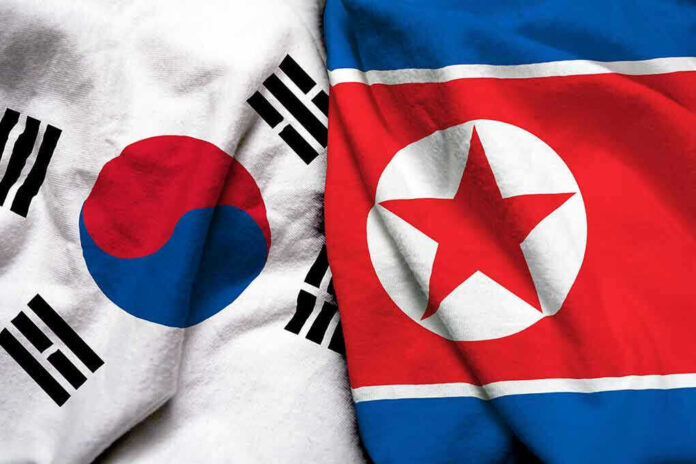
North Korea just slammed the door on South Korea’s new president and threw every olive branch straight back across the DMZ—leaving the world to wonder if there’s any hope left for peace on the Korean peninsula, or if it’s all just another round of empty talk with dangerous consequences.
At a Glance
- North Korea’s Kim Yo Jong publicly rejected all peace overtures from South Korea’s new President Lee Jae Myung.
- Pyongyang’s hardline stance signals a deepening divide and the solidification of the “two hostile states” doctrine.
- South Korea’s attempts at conciliation—including halting propaganda and repatriating fishermen—were dismissed as meaningless by the North.
- Regional security remains tense, with no sign that dialogue or reconciliation will resume any time soon.
North Korea’s “Nothing to Discuss”: Kim Yo Jong Mocks Seoul’s Peace Push
Kim Yo Jong, the formidable sister of Kim Jong Un, didn’t mince words when she torched South Korea’s latest peace offering. With President Lee Jae Myung barely settled in, his attempts to cool tensions—halting border propaganda, sending fishermen home, even pleading with activists to stop dropping leaflets—were swatted aside as “futile.” North Korea’s message: there’s “nothing to discuss.” The regime’s disdain couldn’t be clearer, and their statement, splashed across state media, reads like a cold slap of reality for anyone who thought a new administration in Seoul might make even a dent in Pyongyang’s iron wall of hostility.
Kim Yo Jong’s rhetoric didn’t stop at dismissing Lee’s gestures. She outright accused the new president of suffering from “blind trust” in the US, implying that any South Korean leader who fails to break with Washington is doomed to be treated as an adversary. The statement even mocked Seoul’s decision to halt border broadcasts, calling it a “reversible turning back of what they should not have done in the first place.” If you hoped for a reset, forget it—North Korea’s rulers are doubling down on confrontation, not cooperation.
History Repeats: Decades of Division and Disappointment
The peninsula has seen this movie before—over and over. Since the 1953 armistice, every glimmer of hope for North-South reconciliation has crashed into the same wall of distrust, saber-rattling, and shifting U.S. alliances. The Sunshine Policy era? Ended in disillusionment. The 2018 summits? Unraveled by disputes over denuclearization and military drills. Every time a South Korean president tries to extend an olive branch, North Korea finds new ways to slam it back. And this time, Kim Jong Un’s regime isn’t even pretending to care about unification rhetoric. After his 2023 declaration that the peninsula is made up of “two states hostile to each other,” the gloves are well and truly off.
President Lee’s election in June 2025 was supposed to mark a new chapter. He tried to dial down the hostilities, suspend the loudspeakers, and urge activists to stop the balloon blitzes. Even repatriating North Korean fishermen—once a major sticking point—produced nothing but shrugs and scorn from Pyongyang. The message is chillingly consistent: the North sees the South as little more than a US puppet, and any sign of goodwill is simply ignored or ridiculed.
Stalemate Deepens: No Hope for Dialogue, Only More Tension
The current freeze shows no sign of thawing. Experts agree that North Korea’s rejection is no tactical bluff—it’s a calculated policy shift, locking in the “two hostile states” paradigm. The border remains a pressure cooker: South Korean border towns live under the threat of garbage balloons, psychological warfare broadcasts, and the ever-present shadow of military escalation. Families divided by the DMZ, humanitarian workers, and anyone who still dreams of reconciliation are left twisting in the wind, with no prospect of aid exchanges or reunions.
Economically, the consequences are just as bleak. Joint ventures like the Kaesong Industrial Complex remain shuttered. Humanitarian organizations face iron-clad barriers to cross-border aid. Political polarization inside South Korea is intensifying, as hawks and doves argue over whether engagement or deterrence is the answer. Meanwhile, Japan, China, and the US watch nervously, knowing that regional stability hangs by a thread.
Expert Analysis: Regime Unity, Global Caution, and Conservative Realism
Analysts point out that Kim Yo Jong’s role as the enforcer and mouthpiece for North Korean policy signals a regime more unified—and more entrenched—than ever. Academic observers argue that Pyongyang’s distrust of Seoul’s alliance with Washington, especially after years of joint military drills, is driving the hardening stance. Some experts speculate that the North might be waiting for bigger concessions or a realignment of US policy before even considering a return to talks, but for now, the door is firmly shut.
For conservatives in America, the lesson here is glaring: weak-kneed appeasement and endless overtures only embolden regimes like North Korea’s. President Lee’s “conciliatory” approach has delivered nothing but ridicule and increased instability. It’s a reminder that peace through strength and a clear-eyed defense of national interests—not wishful thinking—are what keep tyrants in check. The world is watching, and the stakes couldn’t be higher.
Sources:
DW: North Korea – Kim Jong Un’s Sister Rejects South’s Overtures
Korea Herald: North Korea dismisses Seoul’s call for dialogue
NK News: North Korea will never reconcile with South, says Lee’s overtures futile
Bloomberg: North Korea rebuffs new South leader’s attempt to ease tensions
France24: North Korea rejects South’s talks offer