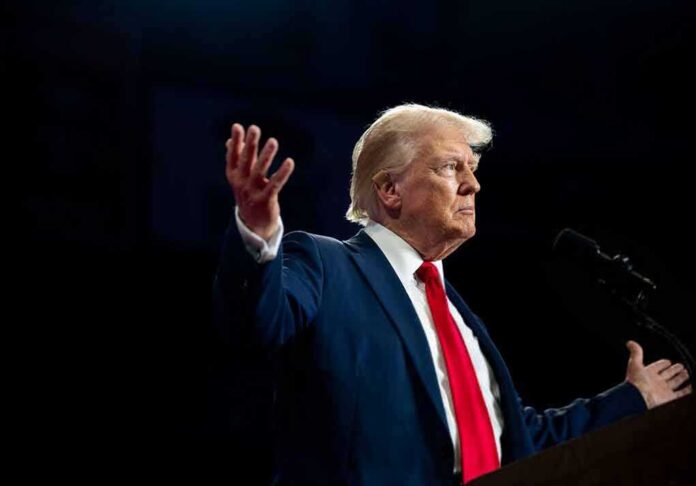
President Trump’s historic cancellation of $4.9 billion in foreign aid funding has sparked fierce debate over executive authority, congressional power, and the fate of programs accused of advancing leftist agendas at taxpayer expense.
Story Snapshot
- The Trump administration used a “pocket rescission” to cancel $4.9 billion in congressionally-approved foreign aid for the first time in 50 years.
- Officials cited the move as an “America First” victory against “woke, weaponized, and wasteful” spending.
- Bipartisan lawmakers condemned the action, warning of legal violations and risks to U.S. global influence.
- The cuts target USAID, State Department programs, and funding for international organizations and peacekeeping.
Pocket Rescission Sparks Constitutional Clash Over Spending
On August 28, 2025, the White House formally notified Congress that it would cancel $4.9 billion in foreign aid appropriations, marking the first use of a “pocket rescission” in half a century. The Trump administration justified the decision as a direct response to what it described as “woke, weaponized, and wasteful” programs, framing the move as a necessary defense of American taxpayers and values. This unprecedented action immediately ignited a political firestorm, exposing deep divisions over who controls the nation’s purse strings and how foreign aid aligns with core national interests.
The “pocket rescission” mechanism referenced by the administration finds its roots in the Impoundment Control Act of 1974, which restricts a president’s authority to unilaterally withhold funds approved by Congress. In this case, the administration acted within a tightly defined 45-day window, challenging decades of bipartisan practice on executive-legislative relations. While Trump officials defended the move as a restoration of fiscal discipline and America-first priorities, lawmakers from both parties voiced sharp objections, calling the maneuver an attack on constitutional checks and balances and questioning its legality. The resulting standoff has forced a national conversation about the limits of presidential power and the future of congressional oversight.
Aid Cuts Target “Woke” Spending, Globalist Priorities
The rescission package targeted a broad swath of foreign aid accounts, including $3.2 billion from USAID’s Development Assistance, hundreds of millions designated for international organizations, peacekeeping, and democracy programs. The administration’s messaging focused on eliminating funding for initiatives perceived as advancing radical or leftist priorities abroad—echoing longstanding conservative frustrations with globalism, government overreach, and taxpayer-funded projects that lack direct benefit to American families. This approach resonated with a base frustrated by years of unchecked spending, border insecurity, and what many see as the export of progressive social policies under the guise of development assistance.
Despite administration claims that the cuts would preserve American sovereignty and fiscal health, critics warn of immediate disruptions to humanitarian and development projects, particularly in impoverished or unstable regions. International organizations that rely on U.S. funding for peacekeeping and health initiatives now face uncertainty, as do contractors and non-governmental organizations operating overseas. The ripple effects extend beyond aid recipients, potentially undermining the U.S.’s ability to shape global events and maintain partnerships critical to national security and economic interests.
Bipartisan Backlash: Legal, Diplomatic, and Humanitarian Risks
Capitol Hill responded with rare bipartisan unity in condemning the administration’s move, with lawmakers warning of “dire consequences” for both America’s global standing and the constitutional separation of powers. Congressional leaders argued that the executive branch overstepped its authority, directly contravening Congress’s exclusive power to appropriate federal funds. Legal scholars joined the chorus of concern, citing potential violations of the Impoundment Control Act and raising the specter of protracted court battles over the fate of the rescinded funds.
On the diplomatic front, foreign governments and international organizations expressed alarm about the sudden withdrawal of promised U.S. support. Humanitarian advocates stressed the likely impact on vulnerable populations, including reduced access to health care, education, and food security programs. Within the United States, nonprofit and faith-based organizations braced for funding shortfalls and operational disruptions, highlighting the complex web of interests that depend on consistent federal engagement abroad.
America First or Global Retreat? Lasting Implications and Ongoing Debate
Supporters of the rescission, including many in the conservative movement, applauded the administration for standing up to entrenched bureaucracies and redirecting resources toward domestic priorities. They argue that America should not be forced to fund foreign programs that undermine traditional values, erode national sovereignty, or reward wasteful spending. Detractors counter that abrupt aid cuts risk ceding geopolitical influence to rivals, damaging alliances, and diminishing the United States’ reputation as a global leader in humanitarian affairs.
WATCH: Trump cuts nearly $5B of foreign aid#News #BreakingNews #USNewshttps://t.co/zSZ27KiQlp
— diegoderosa.net (@diegoderosa_net) August 29, 2025
The controversy over the $4.9 billion rescission has exposed fault lines not only between the executive and legislative branches, but also within the broader debate about America’s role in the world. As legal and policy challenges unfold, the episode will serve as a test case for future administrations seeking to reshape government spending—and for those determined to defend the constitutional order and conservative values amid mounting fiscal and ideological pressures.
Sources:
Lawmakers blast White House move to cancel $4.9B in foreign aid as ‘illegal’
Historic pocket rescission package eliminates woke, weaponized, and wasteful spending